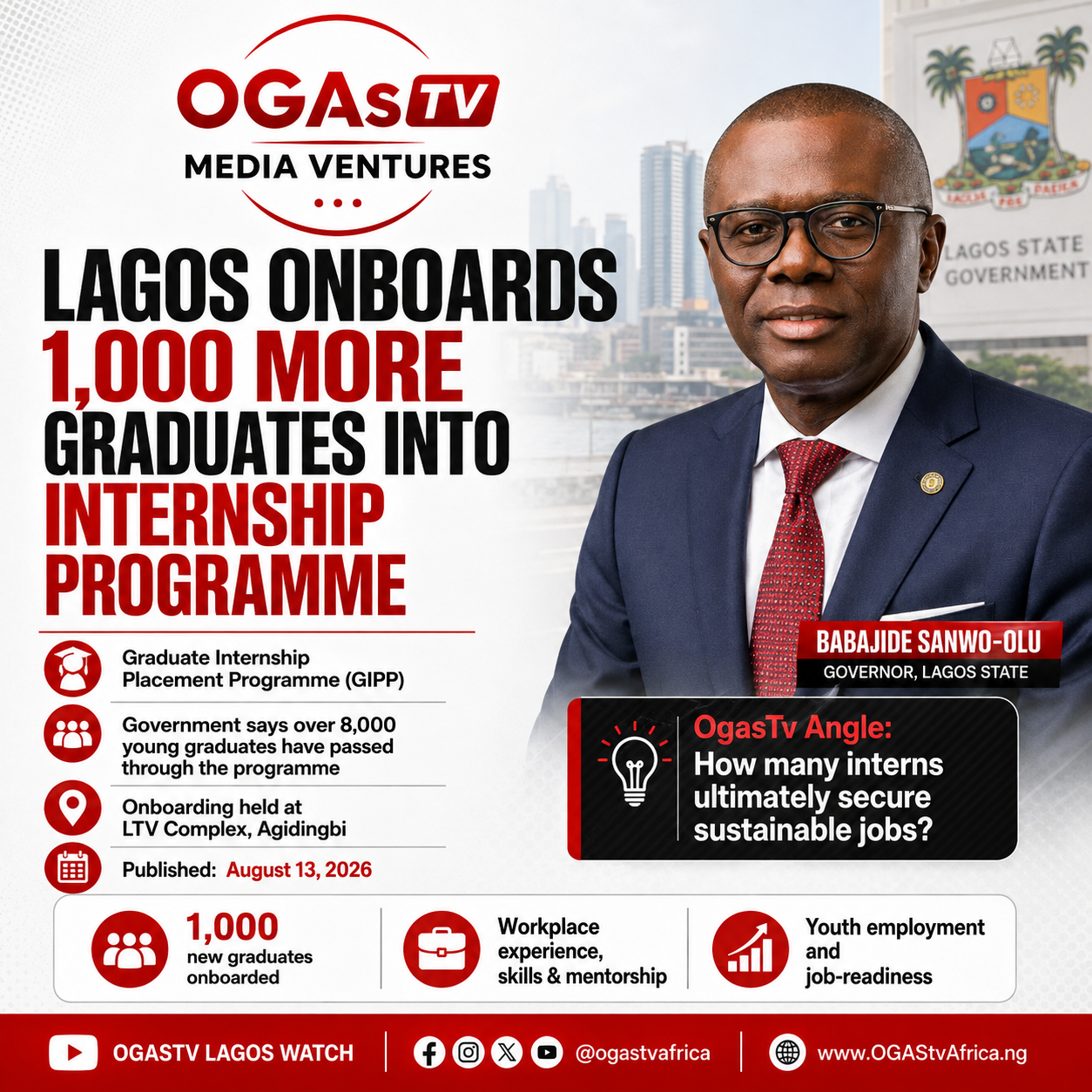
Lagos State has onboarded another 1,000 graduates into its Graduate Internship Placement Programme, GIPP, as part of the government’s wider youth-employment strategy.
Governor Babajide Sanwo-Olu says the latest intake brings the government-reported number of young graduates who have passed through the programme to more than 8,000.
The onboarding exercise was organised by the Lagos State Ministry of Wealth Creation and Employment at the LTV Complex in Agidingbi.
The programme is designed to place graduates with participating organisations where they can gain workplace experience, professional skills, industry exposure and access to mentorship.
Sanwo-Olu also urged participating employers to provide interns with meaningful assignments and proper guidance rather than treating them simply as temporary workers.
That distinction matters.
Internship programmes can help young graduates bridge the gap between education and employment, but their real value depends on what happens after placement.
For OgasTv, the important accountability question is therefore not only:
How many graduates entered the programme?
It is also:
How many ultimately secured sustainable employment?
The state says more than 8,000 graduates have already passed through GIPP, but the newly published information does not provide a detailed breakdown showing how many participants later obtained permanent jobs.
There is also no publicly available council-by-council breakdown showing how many beneficiaries came from communities such as Kosofe, Agboyi-Ketu and Ikorodu.
That matters because programmes designed to address youth unemployment should be measurable not only by statewide participation figures, but by accessibility, geographic distribution and employment outcomes.
What Should Be Measured?
Several indicators would provide a clearer picture of GIPP’s impact:
- Number of graduates placed each year
- Duration of each internship
- Monthly stipend paid to participants
- Participating employers
- Percentage of interns retained by host organisations
- Percentage securing employment elsewhere after completion
- Average time taken to secure employment
- Distribution of beneficiaries across Lagos LGAs and LCDAs
- Participation by sector and profession
- Programme cost relative to employment outcomes
Without these indicators, enrolment numbers alone provide only part of the picture.
The Grassroots Question
For communities including Kosofe, Agboyi-Ketu and Ikorodu, there are practical questions.
How many young graduates from these areas are among the latest 1,000 participants?
How are applicants selected?
Which companies are receiving them?
Are opportunities advertised transparently?
And are participants being matched with roles that correspond to their qualifications and career interests?
These questions matter particularly in communities where youth unemployment and underemployment remain major concerns.
From Internship to Employment
Sanwo-Olu’s call for employers to provide real workplace responsibilities is important because internship programmes become more valuable when participants leave with demonstrable experience, references, skills and professional networks.
But the strongest evidence of success would be measurable job conversion.
If thousands of young Lagosians are passing through the programme, Lagos should eventually be able to show how many graduates moved into permanent employment, entrepreneurship or other sustainable economic activity.
That would allow residents to distinguish between programme reach and programme impact.
OgasTv GIPP Outcomes Tracker
For OgasTv, the next stage should be to track GIPP beyond onboarding ceremonies.
A useful public-interest follow-up would examine:
How many of the latest 1,000 participants come from Kosofe, Agboyi-Ketu and Ikorodu?
What stipend is provided and for how long?
Which employers are involved?
How many previous interns were retained?
And will Lagos State publish a detailed GIPP employment-outcomes report?
A successful youth-employment programme should ultimately be judged by one central metric:
How many young people move from internship to sustainable employment?
OgasTv will continue following the programme from onboarding to measurable employment outcomes.
OgasTv Media Ventures
Youth. Opportunity. Accountability. Impact.
@ogastvafrica
www.OGAStvAfrica.ng
#OGAS #OgasTvAfrica #LagosJobs #GIPP #YouthEmployment #LagosYouth #GraduateInternship #Kosofe #AgboyiKetu #Ikorodu #Employment #YouthDevelopment