OgasTv Africa Economic Watch | August 14, 2026
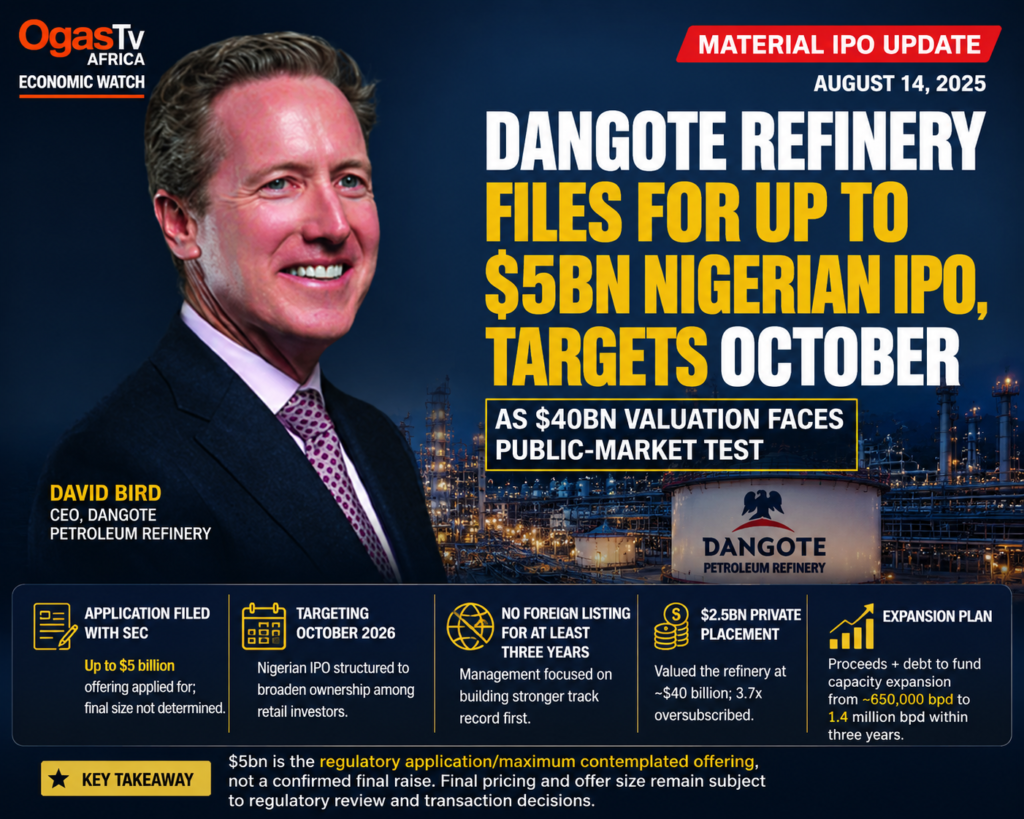
Dangote Petroleum Refinery is moving closer to one of the most consequential public offerings in Nigeria’s capital-market history, with the company targeting an October 2026 listing in Nigeria and seeking regulatory approval for an offering of up to $5 billion.
Dangote Petroleum Refinery Chief Executive Officer David Bird said an application has been submitted to Nigeria’s Securities and Exchange Commission (SEC), although the final amount to be raised has not yet been determined.
The distinction is important: the $5 billion figure represents the maximum contemplated offering under the regulatory application and should not yet be treated as the refinery’s confirmed IPO size.
If completed at or near that level, however, the transaction would represent a major test of both investor appetite for the refinery and the depth of Nigeria’s domestic capital market.
Nigerian Investors at the Centre of IPO Strategy
Management is positioning the proposed IPO primarily as an opportunity to broaden Nigerian ownership of the refinery, including participation by retail investors.
The strategy indicates that Dangote Refinery’s immediate public-market priority is Nigeria rather than pursuing simultaneous listings in Nigeria and an international financial centre.
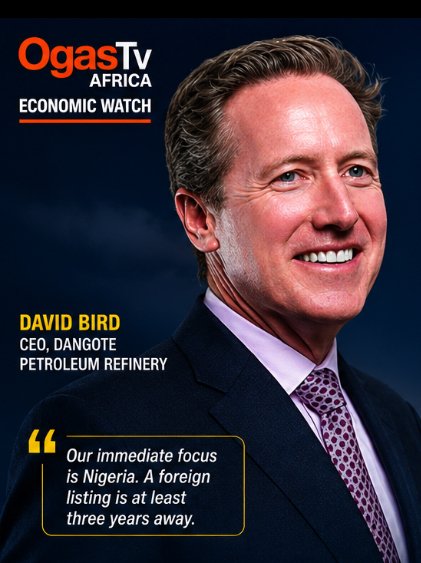
Bird said management does not expect a foreign listing for at least three years.
The company instead intends to establish a stronger operating, production and financial track record before potentially entering an overseas market. London has been identified as one possible future destination.
That approach could allow investors to assess the refinery over several reporting periods before management attempts to secure an international-market valuation.
$40bn Valuation Faces Its Next Test
The IPO comes shortly after Dangote Refinery completed a $2.5 billion private placement in July, led by Africa Finance Corporation and other strategic investors.
That transaction reportedly valued the refinery at approximately $40 billion and attracted demand equivalent to about 3.7 times the shares available.
The oversubscription provides an important indicator of institutional demand, but an IPO would introduce a different valuation test.
Private-placement valuations are negotiated among a comparatively small group of investors. A public offering exposes the company to a much broader pool of institutional and retail investors and creates an observable market price for its equity.
The crucial question therefore becomes whether public investors will support a valuation around, above or below the approximately $40 billion benchmark established during the private placement.
IPO Could Help Finance 1.4 Million Bpd Expansion
The capital raise is also connected to Dangote Refinery’s ambitious expansion programme.
The refinery currently has capacity of roughly 650,000 barrels per day, but management plans to increase this to approximately 1.4 million barrels per day within three years.
IPO proceeds, combined with debt financing, are expected to contribute to funding that expansion.
Reaching the target would more than double the refinery’s existing nameplate capacity and substantially increase the scale of Dangote’s refining operations.
For investors, however, capacity alone will not determine valuation.
Markets will increasingly focus on actual utilisation rates, refining margins, product sales, operating cash flow, debt levels, capital expenditure requirements and the refinery’s ability to translate its enormous industrial scale into sustainable earnings.
Why the Final SEC-Approved Structure Matters
The next major development will be the SEC-approved offer structure.
Several numbers will determine what the transaction actually means for investors and Dangote Refinery’s valuation:
- The final amount the company decides to raise.
- The percentage of the refinery being offered to investors.
- The IPO share price and pricing methodology.
- The resulting pre-money and post-money valuation.
- The allocation between Nigerian retail and institutional investors.
- The proportion of proceeds directed toward expansion, refinancing or other corporate purposes.
For example, raising $5 billion does not by itself establish the refinery’s valuation. The valuation depends on how much equity investors receive in exchange for that capital.
A $5 billion offering representing 10% of the post-transaction company would imply a materially different valuation from the same amount being raised for a 15% or 20% interest.
That makes the final offer document significantly more important than the headline fundraising ceiling.
A Major Test for Nigeria’s Capital Market
Beyond Dangote Refinery itself, the proposed IPO could have wider implications for Nigeria’s equity market.
A transaction of this scale could expand domestic participation in one of Africa’s largest industrial assets, attract significant institutional capital and potentially deepen retail participation in Nigerian equities.
It could also establish an important precedent for other large privately controlled Nigerian companies considering public-market financing.
For Dangote Refinery, the October target therefore represents more than another fundraising exercise.
The company is preparing to move from valuations established through private transactions toward a valuation tested directly by public investors.
OgasTv Africa Economic Watch assessment: The headline number is currently “up to $5 billion,” not a confirmed $5 billion raise. The decisive valuation event will come when regulators approve the offer structure and investors can see exactly how much equity is being sold, at what price and at what implied valuation.
OgasTv Africa Economic Watch — Tracking the capital, companies and investments shaping Africa’s economy.