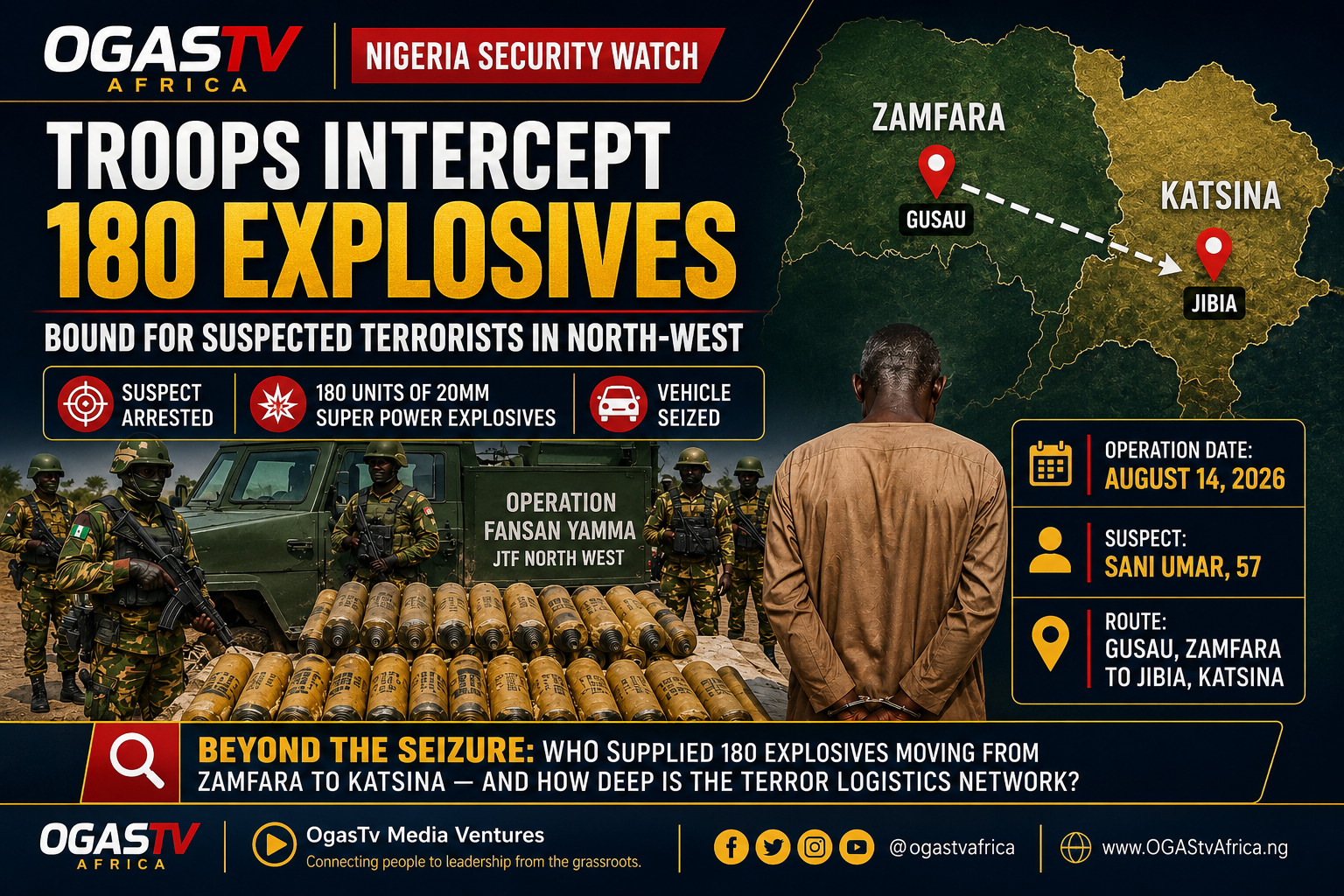
Troops of the Joint Task Force North West, Operation FANSAN YAMMA, have intercepted a suspected explosives courier and recovered 180 units of 20mm Super Power explosives allegedly being transported from Gusau in Zamfara State toward Jibia in Katsina State.
The operation took place on Friday, August 14, 2026, and was disclosed publicly on August 15 by the task force’s Media Information Officer, Lt.-Col. Aliyu Danja.
The suspect was identified by the military as 57-year-old Sani Umar.
According to the task force, Umar, the vehicle used in the movement and the recovered explosives are currently in custody as investigations continue.
The military says the consignment was suspected to be destined for terrorist elements operating around Jibia, a border-area corridor in Katsina State.
Why the Seizure Matters
The interception is significant because the potential value of the operation goes beyond removing explosives from circulation.
The larger security question is whether the seizure exposes a wider logistics and supply network supporting armed groups operating across the Zamfara-Katsina axis.
Terrorist and bandit groups do not operate on weapons alone. Sustained operations require transport, financing, procurement, storage, communications and intermediaries capable of moving materials between towns, rural settlements and operational bases.
That makes a suspected courier potentially more useful to investigators than the physical explosives themselves.
If the military can establish where the consignment originated, who financed it, who supplied the materials and who was expected to receive them, the investigation could reveal a broader support chain.
What Was Recovered
The military says troops recovered:
- 180 units of 20mm Super Power explosives
- the vehicle allegedly used for transportation
The suspect and recovered items were taken into military custody for further investigation.
At this stage, the military has not publicly disclosed the exact commercial or industrial source of the explosives.
That remains one of the most important unanswered questions.
Separate Operation in Birnin Magaji
The explosives interception was not the only security operation reported by Operation FANSAN YAMMA on August 14.
In a separate clearance operation in Birnin Magaji Local Government Area of Zamfara State, troops reported killing two terrorists.
The military also said troops recovered:
- two rifles
- two magazines
- nine rounds of ammunition
- two motorcycles
The troops subsequently encountered an attempted ambush but reportedly fought through the attack.
The two incidents together reflect continued pressure on both armed groups and the support networks that sustain them.
The Bigger Security Question: Who Supplies the Supply Chain?
The seizure raises several questions that go directly to counterterrorism strategy.
Where were the explosives obtained?
Were they diverted from a legitimate mining, construction, quarrying or industrial supply chain?
Was the suspect acting alone, or as part of an organised network?
Who financed the movement?
Who was meant to receive the consignment in Jibia?
Were there previous deliveries along the same route?
These are the questions that will determine whether the interception becomes a one-off seizure or the beginning of a wider disruption of terrorist logistics.
What Is Confirmed
The following points are confirmed from the military disclosure:
- 180 explosive units were recovered
- one suspect was detained
- a vehicle was taken into custody
- the military says the movement originated from the Gusau area in Zamfara and was headed toward Jibia in Katsina
- investigation is ongoing
What Remains Unconfirmed
Several important claims remain unresolved.
It has not yet been established publicly whether Sani Umar knowingly worked for a specific terrorist organisation.
The exact origin of the explosives has not been disclosed.
No financier or supplier has been identified publicly.
The military has also not announced whether other suspected members of the logistics network have been arrested.
Those points should remain treated as open investigative questions rather than established facts.
Why This Matters More Than a Routine Battlefield Update
Security reporting often focuses on casualty figures, recovered weapons and the number of armed fighters killed.
But disrupting logistics can have a deeper operational impact.
Armed groups depend on continuous access to ammunition, explosives, fuel, motorcycles, communications equipment, food, intelligence and cash.
If security agencies are able to identify and dismantle the people and commercial channels supplying these materials, they can reduce the operational capacity of terrorist groups without relying only on direct combat.
That is why the 180-unit explosives seizure deserves close attention.
OgasTv Accountability Watch
OgasTv will be tracking five specific issues as the investigation develops:
- the source of the explosives
- the intended recipients
- the financing chain
- any commercial or industrial diversion route
- further arrests linked to the suspected supply network
The key question is no longer simply how many explosives were seized.
It is whether investigators can trace the consignment backward to its supplier and forward to its intended beneficiaries.
If that chain is exposed, the operation could become significantly more important than the initial interception itself.
OgasTv Africa — Connecting people to leadership from the grassroots.