OGASTV NIGERIA | Project & Policy Explained
⸻
QUICK SUMMARY
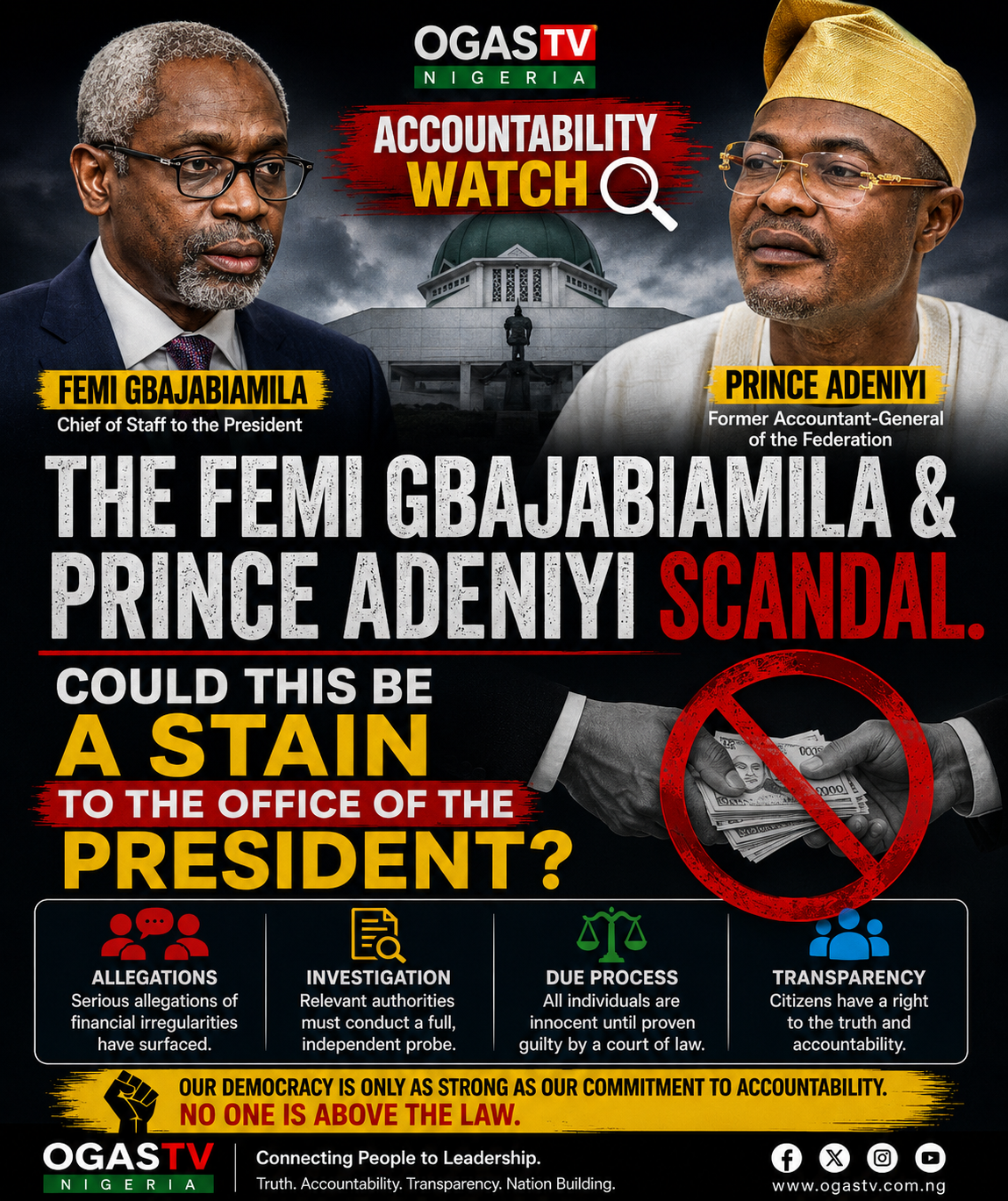
In early July 2026, a man named Adeniyi Adeyemi Matthew publicly accused Femi Gbajabiamila, Chief of Staff to President Bola Tinubu, of demanding ₦27.4 billion and receiving ₦400 million through proxies to secure Matthew’s appointment as head of a federal council. The Presidency flatly denies this, says the council doesn’t exist, and says Matthew is facing criminal charges for forgery and impersonation. As of this writing, Gbajabiamila has not been charged with any offence, and the matter is unresolved. This piece lays out what’s actually documented on each side — not a verdict.
⸻
WHAT HAPPENED
Adeniyi Adeyemi Matthew, who identified himself as Director-General of a body called the Presidential Foreign Intervention Promotion Council (also referenced as the Presidential Foreign Investment Promotion Council) and the Presidential Economic Advisory Council, alleged that Gbajabiamila demanded 48% of the council’s ₦27.4 billion take-off grant, received ₦400 million through proxies to facilitate his appointment, and was owed an outstanding ₦200 million balance. Matthew claimed tensions over that balance led to threats against his life, and called for an independent investigative panel involving civil society and international bodies.
The Presidency’s response, delivered through Special Adviser on Information and Strategy Bayo Onanuga, was direct denial: no such council exists under the Tinubu administration, Gbajabiamila’s office issued no appointment letter, and Matthew is, in the Presidency’s account, an impostor who forged presidential documents and operated multiple fictitious government-linked bank accounts — reportedly 34 in total, including one at the Central Bank of Nigeria opened through alleged misrepresentation. The Presidency states Gbajabiamila himself petitioned security agencies about the alleged forgery scheme back in October 2025 — before Matthew’s public allegations — and that the Ministry of Foreign Affairs and the Nigerian Investment Promotion Commission had separately raised concerns about the council’s legitimacy.
Matthew and two others were arraigned before the Federal High Court in Abuja in November 2025 on an eight-count charge covering conspiracy, forgery, and impersonation, including allegations that he forged a presidential appointment letter and other official documents. That case is adjourned to 27 July 2026.
What’s genuinely unresolved: whether Gbajabiamila had any actual involvement in Matthew’s appointment or received any funds, as Matthew alleges and the Presidency flatly denies. Civil society is visibly split on how to interpret this. A coalition described as over 300 to 350 civil society organisations has publicly defended Gbajabiamila, citing his legislative record as former Speaker. Separately, the Committee for the Defence of Human Rights (CDHR) has called on him to voluntarily step aside pending an independent investigation — explicitly stating this is not a presumption of guilt, but a standard accountability safeguard. The opposition Nigeria Democratic Congress (NDC) has called for his removal and a formal probe. Human rights lawyer Femi Falana, who is defending Matthew in the forgery case, has asked that Gbajabiamila submit all official documents signed since taking office for forensic examination, and has called for equal scrutiny of all parties involved — not asserted that Gbajabiamila is guilty.
One detail raised by CDHR deserves separate attention regardless of how the personal allegation resolves: the group states that the disputed council reportedly appeared in Nigeria’s 2026 Appropriation Act with budgetary allocations running into billions of naira, despite now being described by the Presidency as entirely fictitious. If accurate, that is a distinct, verifiable institutional question — how a non-existent agency secured a line in the national budget — separate from whether any individual committed wrongdoing.
⸻
WHY DID IT HAPPEN
Nigeria’s federal appointment and agency-creation processes involve multiple offices — the Chief of Staff’s office, the Secretary to the Government of the Federation, and various ministries — and the Presidency’s own account acknowledges that concerns about this specific council’s legitimacy existed within government (at the Ministry of Foreign Affairs and the Nigerian Investment Promotion Commission) before the matter became public. Whether those internal concerns were acted on quickly enough, and how a disputed entity may have reached the Appropriation Act if the claims are accurate, are open institutional questions independent of the personal bribery allegation.
⸻
WHY SHOULD CITIZENS CARE
This story tests two things at once that citizens genuinely need functioning: whether senior government officials can be investigated fairly without either shielding them from scrutiny or destroying reputations based on unproven claims, and whether Nigeria’s budget process has verification safeguards strong enough to prevent a disputed or fictitious entity from receiving public funds. Both questions matter regardless of how the personal allegation against Gbajabiamila is ultimately resolved.
⸻
WHAT CAN GOVERNMENT DO
• Support, rather than resist, an independent verification process for the core factual dispute — whether Gbajabiamila’s office issued any appointment or received any funds — since a credible, transparent resolution protects him if the allegation is false and protects public trust if it is not.
• Explain clearly and publicly how the disputed council reportedly reached the Appropriation Act, if that claim is accurate, since this is a verifiable budget-process question distinct from the personal allegation, and citizens deserve to know how such an entity could receive budget lines.
• Ensure Matthew’s prosecution proceeds transparently, given the scale of the allegations against him (34 bank accounts, forged presidential documents, impersonation), so the outcome of his trial can help clarify the underlying facts for the public.
• Protect all parties’ safety and due process rights equally — Matthew has alleged threats against his life; regardless of the merits of his claims against Gbajabiamila, any credible threat to a witness or accuser in an active legal matter deserves independent investigation.
⸻
WHAT CAN CITIZENS DO
• Resist drawing a conclusion before the facts are established. Neither “he is obviously guilty” nor “he is obviously innocent” is currently supported by verified, independent findings — both are, at this stage, positions taken by interested parties.
• Watch the 27 July court date, since Matthew’s own criminal trial may surface evidence relevant to the wider dispute, even though it is formally a case about Matthew’s alleged forgery and impersonation, not a case against Gbajabiamila.
• Ask specifically about the Appropriation Act question, since that is the most concrete, checkable claim in this entire story — either the disputed council appears in the 2026 budget documents or it does not, and that is a matter of public record that can be independently verified.
⸻
WHAT LEADERSHIP LESSON CAN AFRICA LEARN
The instinct to declare a public figure guilty the moment an accusation surfaces is understandable — accusations against powerful people are often true, and history is full of cases where premature defenses of the powerful turned out to be wrong. But the instinct to declare a public figure guilty without any independent finding, charge, or verified evidence carries its own real cost: it can permanently damage a reputation that may be entirely innocent, while giving actual wrongdoing, wherever it exists, less rigorous scrutiny than a fair, evidence-based process would provide. Nigeria’s institutions — courts, the EFCC, ICPC, and independent civil society — exist precisely to make that determination through evidence, not through public sentiment alone. The healthiest form of accountability journalism holds government to that same standard, rather than substituting public suspicion for it.