National Intermediate Games is a big task, says Omotoso
The Chairman, Media and Publicity Sub-committee for Lagos 2026 National Intermediate Games, Gbenga Omotoso has charged all committee members to see the Games as a priority event that must be delivered.
OGASTV NIGERIA | Opportunity Watch
⸻
QUICK SUMMARY
From October 1 to October 15, 2026, Lagos will host the maiden edition of Nigeria’s National Intermediate Games, a new, NSC-approved competition built specifically as a bridge between grassroots sport and the elite National Sports Festival level, open to athletes aged 16 to 19 from all 36 states and the FCT. The bigger story for most readers isn’t just the competition itself — it’s the wide range of roles, from athlete to media professional to volunteer, that a first-of-its-kind national event like this genuinely opens up.
⸻
WHAT HAPPENED
Lagos State was formally announced as host of the inaugural National Intermediate Games by the National Sports Commission, with Governor Babajide Sanwo-Olu inaugurating 13 sub-committees in 2026 to coordinate the event, chaired by the Local Organising Committee under Deputy Chief of Staff Sam Egube. The Games will run October 1-15, 2026, mirroring the National Sports Festival’s format, with 15 compulsory sports including athletics, football, basketball, swimming, wrestling, boxing, tennis, volleyball, and weightlifting. Teslim Balogun Stadium is undergoing infrastructure upgrades, including a new grass surface, on schedule for completion by September 2026. A newly created “Invited Diaspora Athletes” team will also make its debut appearance at this first edition.
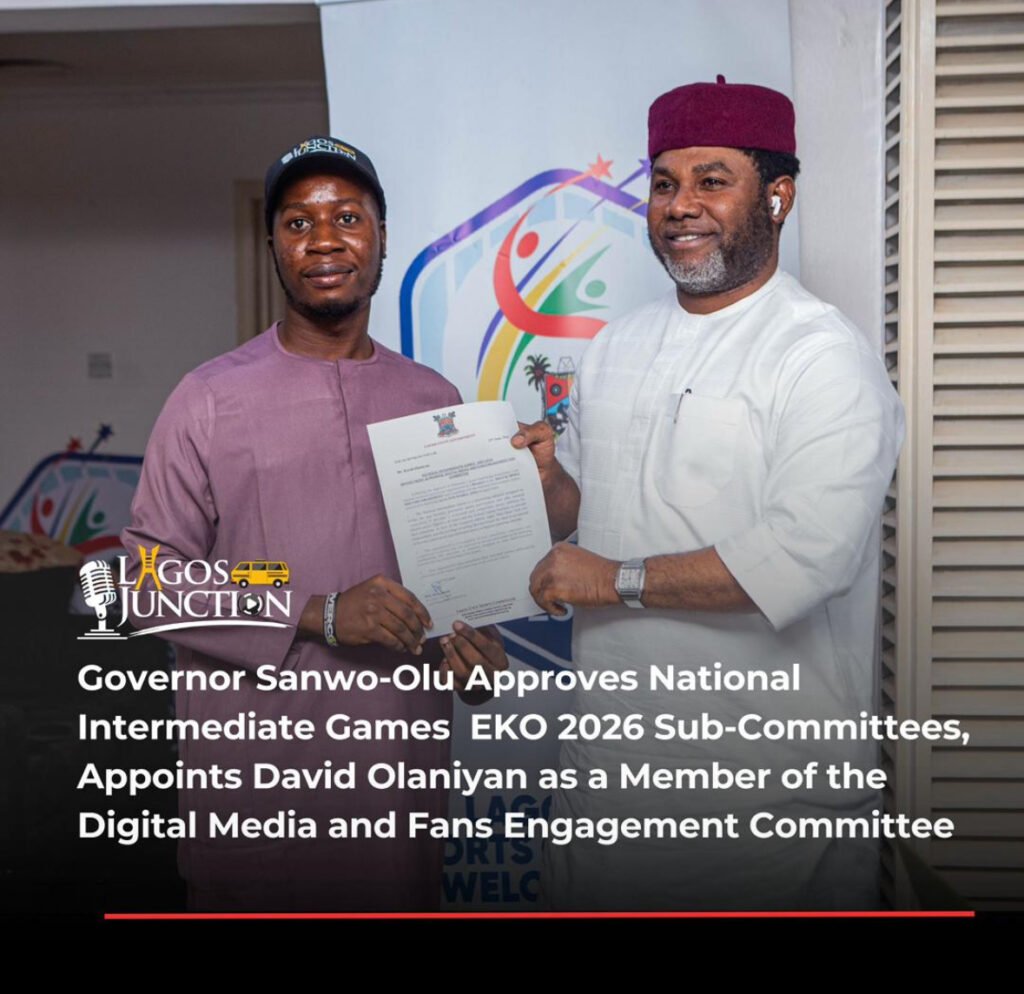
Among the appointments to the Games’ organising structure, Lagos State has named David Olaniyan, founder of Lagos Junction Media and Communications Limited, to the Digital Media and Fans Engagement Sub-Committee, according to the appointment announcement. Olaniyan built Lagos Junction from a standing start in January 2024 into a recognised Lagos-focused media brand, and has separately been active in the Lagos State Youth Parliament. His appointment reflects a broader pattern worth noting: this Games’ organisational structure is deliberately pulling in youth-oriented media and communications talent, not only sports administrators, to run its digital and fan engagement strategy.
⸻
WHY DID IT HAPPEN
The National Sports Commission created the Intermediate Games specifically to close a structural gap in Nigeria’s athlete development pipeline between school-level or state-level competition and the National Sports Festival, Nigeria’s top domestic multi-sport event. Lagos was selected as host based on its track record of large-scale event delivery, including having hosted the first-ever National Sports Festival historically. Because this is a brand-new competition with no prior edition to model logistics on, organisers have needed to build out a full committee structure including a dedicated digital media and fan engagement function largely from scratch, which is why new, non-traditional appointments like Olaniyan’s are notable rather than routine.
⸻
WHY SHOULD CITIZENS CARE
For most Nigerians, “national sports festival” typically means something distant — elite athletes, established federations, and limited public involvement. The Intermediate Games’ age bracket (16-19) and its intentional design as a bridge competition mean a genuinely new generation of Nigerian teenagers, from all 36 states, will compete on a national stage for the first time in October. Beyond the athletes themselves, an event of this scale creates real, if temporary, roles in media coverage, digital content, event logistics, and youth engagement — work that doesn’t require an athletic background to be part of.
⸻
WHAT CAN GOVERNMENT DO
• Publish clear, public criteria for how young athletes qualify to represent their state at the Games, so participation doesn’t depend on informal access or connections within state sports associations.
• Extend media and digital engagement opportunities beyond appointed committee members, by opening accreditation, content, or freelance opportunities to young Nigerian sports journalists and content creators around the country, not just Lagos-based professionals.
• Ensure the Teslim Balogun Stadium upgrade and other infrastructure work stays on its stated September 2026 timeline, since any delay this close to the October 1 start date would directly affect athletes and spectators alike.
• Document and publish outcomes after the Games conclude — participation numbers, standout athletes, and lessons learned — so the stated goal of building “a lasting sports legacy” is measured, not just announced.
⸻
WHAT CAN CITIZENS DO
• Young athletes aged 16-19 should contact their state sports commission or ministry of sports directly to ask about trials or selection processes for their state’s Intermediate Games team.
• Aspiring sports media professionals and content creators should watch for accreditation announcements as the October dates approach — a first-of-its-kind national event is exactly the kind of opportunity that can build a portfolio quickly.
• Parents and schools with teenagers in this age bracket should ask their state sports associations now, rather than waiting until closer to October, since qualifying and preparation timelines are typically set well in advance of a competition.
• Nigerians in the diaspora with teenage children in the relevant age range should look into the newly created “Invited Diaspora Athletes” pathway, which is specifically designed to include diaspora-based young Nigerian athletes in this first edition.
⸻
WHAT OPPORTUNITIES EXIST
• Athlete participation across 15 compulsory sports for Nigerians aged 16-19, representing any of the 36 states or the FCT — the core, direct opportunity of the Games.
• The Invited Diaspora Athletes (IDA) pathway, newly created for this edition, offering diaspora-based young Nigerians a route to national-level competition.
• Media, digital content, and fan engagement roles, illustrated by appointments like Olaniyan’s, suggesting the LOC is actively building out capacity in this area beyond a single appointee.
• Volunteer and event operations roles, typical of large multi-sport competitions of this scale, likely to open closer to the October dates as logistics are finalised.
⸻
WHAT LEADERSHIP LESSON CAN AFRICA LEARN
Building a brand-new national institution — as the Intermediate Games is, in its maiden year — requires more than announcing a competition date. It requires deliberately building the surrounding structure: infrastructure, athlete pathways, media strategy, and diaspora inclusion, often simultaneously and under real time pressure. Lagos’s approach of standing up 13 distinct sub-committees, rather than a single organising body trying to do everything, reflects a leadership principle worth noting: complex, first-of-its-kind national projects tend to succeed when responsibility is deliberately distributed across specialists, rather than concentrated in a way that inevitably creates
ABOUT OPPORTUNITY WATCH
Opportunity Watch is OgasTv Africa’s series dedicated to surfacing real, current opportunities across business, finance, education, and innovation — helping Africans see not just what is happening in their economy, but where they can practically get involved.
By: Oyegbade Adeniyi
OGASTV AFRICA, NIGERIA 🇳🇬