
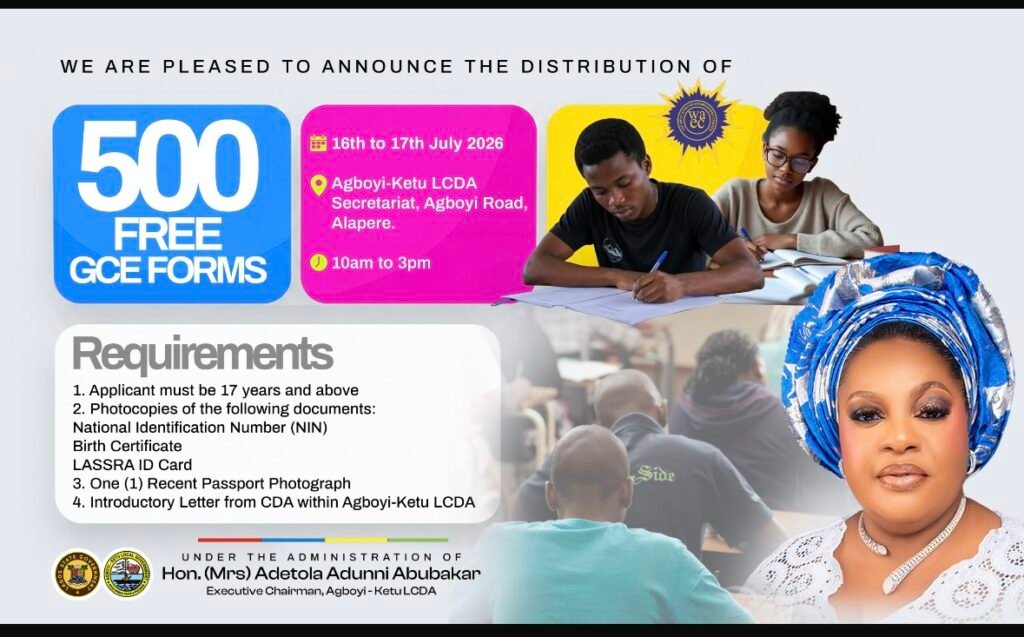
There is something quietly hopeful about watching teenagers bent over exam papers, pencils moving fast, futures riding on every answer. That was the scene this week at the Agboyi-Ketu LCDA Secretariat in Alapere, where the local government, under the administration of Hon. (Mrs) Adetola Adunni Abubakar, distributed 500 free WAEC GCE forms to young people across the council.
OGAsTV Nigeria was on ground to speak with some of the students who benefited. For families who might otherwise have struggled to raise the exam fees, this is not a small thing. Credit where it is due: the LCDA chairman deserves recognition for putting resources directly into the hands of young people at a moment when the cost of education in Nigeria continues to climb.
But a single gesture, however generous, is not the same as a system. And the question this newsroom keeps returning to is simple: if roughly 500 young people move through this process in Agboyi-Ketu each cycle, hoping to pass their GCE and step into adulthood, what happens to them next? We have through the NYCN COMMITTEE TO advocate for the development of business around Agboyi Ketu Such As Agboyi Klin Pure Water Factory and more trade logistics hubs.
The Gap Between Graduation and Opportunity
Nigeria’s youth unemployment problem is well documented at the national level, but it is lived at the local level, in wards, in LCDAs, in towns like Agboyi-Ketu. A free exam form gets a young person through a gate. It does not tell them what is on the other side of it.
So we are asking, on the record: how many registered businesses, industries, or structured employers exist within Agboyi-Ketu LCDA capable of absorbing school leavers into apprenticeships, internships, or entry-level work? Is there a local government-backed pipeline a skills acquisition centre, a vocational partnership, a job placement scheme designed to catch these students in the five to ten years after they sit their GCE?
If the answer is unclear even to us as a newsroom, it is worth asking whether it is clear to the young people themselves.
A Message to the Kosofe Constituency and the State House of Assembly
This is not a criticism aimed only at the Agboyi-Ketu LCDA. Local governments in Nigeria operate with genuinely limited financial autonomy, and much of what shapes long-term youth outcomes industrial policy, large-scale investment, state-level skills programmes sits above the LCDA’s pay grade, with the Kosofe Constituency lawmakers at the Lagos State House of Assembly and with the state government itself.
That is precisely why this editorial is addressed upward as much as it is addressed locally. If Agboyi-Ketu is doing its part funding forms, keeping children in the exam pipeline. what is the Assembly doing to ensure the budget lines exist for the next stage?
Where in the state’s economic planning is there a deliberate, trackable answer to: what happens to LCDA school leavers after they graduate?
Nigeria does not lack good intentions at the grassroots. It lacks systems that connect one good intention to the next.
A council that pays for GCE forms should be matched by a constituency that funds skills centres, and a state that attracts industry to absorb the graduates those centres produce. Anything less is a relay race where the baton gets dropped at the second leg.
The Big Ask
We are not asking Hon. Abubakar to solve youth unemployment single-handedly that would be both unfair and unrealistic. We are asking that this moment of goodwill become the opening line of a longer conversation, one that includes Kosofe’s Assembly representatives and the wider machinery of Lagos State government.
Nigeria’s young people do not need charity alone. They need a government that is systematic from the ward to the Assembly to the state budget about ensuring that passing an exam actually leads somewhere.
OGAsTV Nigeria will continue to follow this story and has reached out for comment from Agboyi-Ketu LCDA and Kosofe Constituency representatives. This piece will be updated as responses are received.