

The debate over state police in Nigeria has entered a new phase. While both chambers of the National Assembly have passed constitutional amendment bills to establish state police, the proposal has not yet become law. Because it amends the Constitution, it still requires approval by at least 24 of the 36 State Houses of Assembly before it can be transmitted to the President for assent. More recently, the House of Representatives also withdrew its own version to consider a similar Executive-backed proposal, effectively putting the legislative process on hold while lawmakers work towards a harmonised version. (Channels Television)
What is the State Police Bill?
The bill seeks to change Nigeria’s policing structure from a single federal police system to a dual policing system, where:
- The Nigeria Police Force continues to handle national security matters such as terrorism, border security and organised crime.
- Individual states may establish their own State Police Services to handle local policing and community security. (Premium Times Nigeria)
Why are many Nigerians supporting state police?
Supporters argue that Nigeria’s current centralised police system is overstretched and unable to respond quickly to the country’s growing security challenges.
They believe state police could:
- Improve response times to crimes.
- Strengthen community policing.
- Provide officers with better local knowledge of languages, culture and terrain.
- Help tackle banditry, kidnapping, cultism and communal clashes more effectively.
- Allow governors, who are often called the “Chief Security Officers” of their states, to have operational control over security within their jurisdictions. (Reuters)
Why are some Nigerians opposed?
Critics fear that state police could be abused by state governments.
Common concerns include:
- Governors using state police to intimidate political opponents.
- Interference in elections.
- Harassment of journalists and activists.
- Selective enforcement of the law.
- Weak oversight mechanisms.
Nigeria’s political history includes periods when regional policing structures were accused of political misuse, making some observers cautious about decentralising police powers. (AP News)
What safeguards are in the bill?
According to the version passed by the National Assembly, the proposal includes several safeguards, including:
- State Commissioners of Police would be appointed by governors but confirmed by State Houses of Assembly.
- The Federal Government would retain responsibility for national security functions.
- In exceptional circumstances, the President could temporarily assume operational control of a state police service under conditions set out in the legislation. (Channels Television)
Why is the bill considered important now?
Nigeria continues to face serious security challenges, including:
- Kidnappings for ransom.
- Bandit attacks.
- Terrorism and insurgency.
- Farmer-herder conflicts.
- Violent crime in urban areas.
Supporters argue that creating state police would allow security responses to be more localised and responsive. Opponents, however, insist that governance reforms, accountability and adequate funding must accompany any decentralisation. (Reuters)
What happens next?
Before the proposal can become part of the Constitution, it must:
- Be approved by at least two-thirds of Nigeria’s State Houses of Assembly.
- Be harmonised where necessary between legislative versions.
- Be transmitted to the President for assent after the constitutional requirements are met. (Channels Television)
Editorial perspective
The state police debate is not simply about creating another security agency. It raises broader questions about Nigeria’s federal structure, accountability and public safety.
Those in favour argue that no single federal police force can effectively police a country of more than 200 million people with diverse security challenges. Those against caution that decentralising policing without strong checks and balances could create new opportunities for political abuse.
Ultimately, if state police are established, their success will depend less on the constitutional amendment itself and more on independence, professional standards, transparent oversight, adequate funding and respect for the rule of law. Without those safeguards, simply creating new police forces may not resolve the underlying security challenges Nigeria faces.
What is the State Police Bill?
The bill seeks to change Nigeria’s policing structure from a single federal police system to a dual policing system, where:
- The Nigeria Police Force continues to handle national security matters such as terrorism, border security and organised crime.
- Individual states may establish their own State Police Services to handle local policing and community security. (Premium Times Nigeria)
Why are many Nigerians supporting state police?
Supporters argue that Nigeria’s current centralised police system is overstretched and unable to respond quickly to the country’s growing security challenges.
They believe state police could:
- Improve response times to crimes.
- Strengthen community policing.
- Provide officers with better local knowledge of languages, culture and terrain.
- Help tackle banditry, kidnapping, cultism and communal clashes more effectively.
- Allow governors, who are often called the “Chief Security Officers” of their states, to have operational control over security within their jurisdictions. (Reuters)
Why are some Nigerians opposed?
Critics fear that state police could be abused by state governments.
Common concerns include:
- Governors using state police to intimidate political opponents.
- Interference in elections.
- Harassment of journalists and activists.
- Selective enforcement of the law.
- Weak oversight mechanisms.
Nigeria’s political history includes periods when regional policing structures were accused of political misuse, making some observers cautious about decentralising police powers. (AP News)
What safeguards are in the bill?
According to the version passed by the National Assembly, the proposal includes several safeguards, including:
- State Commissioners of Police would be appointed by governors but confirmed by State Houses of Assembly.
- The Federal Government would retain responsibility for national security functions.
- In exceptional circumstances, the President could temporarily assume operational control of a state police service under conditions set out in the legislation. (Channels Television)
Why is the bill considered important now?
Nigeria continues to face serious security challenges, including:
- Kidnappings for ransom.
- Bandit attacks.
- Terrorism and insurgency.
- Farmer-herder conflicts.
- Violent crime in urban areas.
Supporters argue that creating state police would allow security responses to be more localised and responsive. Opponents, however, insist that governance reforms, accountability and adequate funding must accompany any decentralisation. (Reuters)
What happens next?
Before the proposal can become part of the Constitution, it must:
- Be approved by at least two-thirds of Nigeria’s State Houses of Assembly.
- Be harmonised where necessary between legislative versions.
- Be transmitted to the President for assent after the constitutional requirements are met. (Channels Television)
Editorial perspective
The state police debate is not simply about creating another security agency. It raises broader questions about Nigeria’s federal structure, accountability and public safety.
Those in favour argue that no single federal police force can effectively police a country of more than 200 million people with diverse security challenges. Those against caution that decentralising policing without strong checks and balances could create new opportunities for political abuse.
Ultimately, if state police are established, their success will depend less on the constitutional amendment itself and more on independence, professional standards, transparent oversight, adequate funding and respect for the rule of law. Without those safeguards, simply creating new police forces may not resolve the underlying security challenges Nigeria faces.
-

LAWMA Clears Olopomeji Refuse Heap After Residents’ Complaints — Will the Fix Last?
KOSOFE LAGOS WATCH — LOCAL DEVELOPMENT LAWMA Clears Refuse Heap in Oworonshoki’s Olopomeji Area After Residents’ Outcry What changed A refuse heap in Olopomeji, Oworonshoki, within Kosofe Local Government Area, was reportedly cleared by the Lagos State Waste Management Authority (LAWMA) following complaints from residents. The cleanup was listed by Kosofe Post as a breaking…
-

Oshinowo Launches Digital 2027 Platform, Opens Volunteer Registration Across Kosofe
KOSOFE POLITICAL WATCH — NEW DEVELOPMENT What changed A new public-service and campaign platform for Mayor Dele Oshinowo is now live at mayordeleoshinowo.org. The site presents his leadership profile, projects and impact record, and includes a dedicated “MDO 2027” section inviting residents to register as volunteers or members of a support group for Mayor Dele…
-
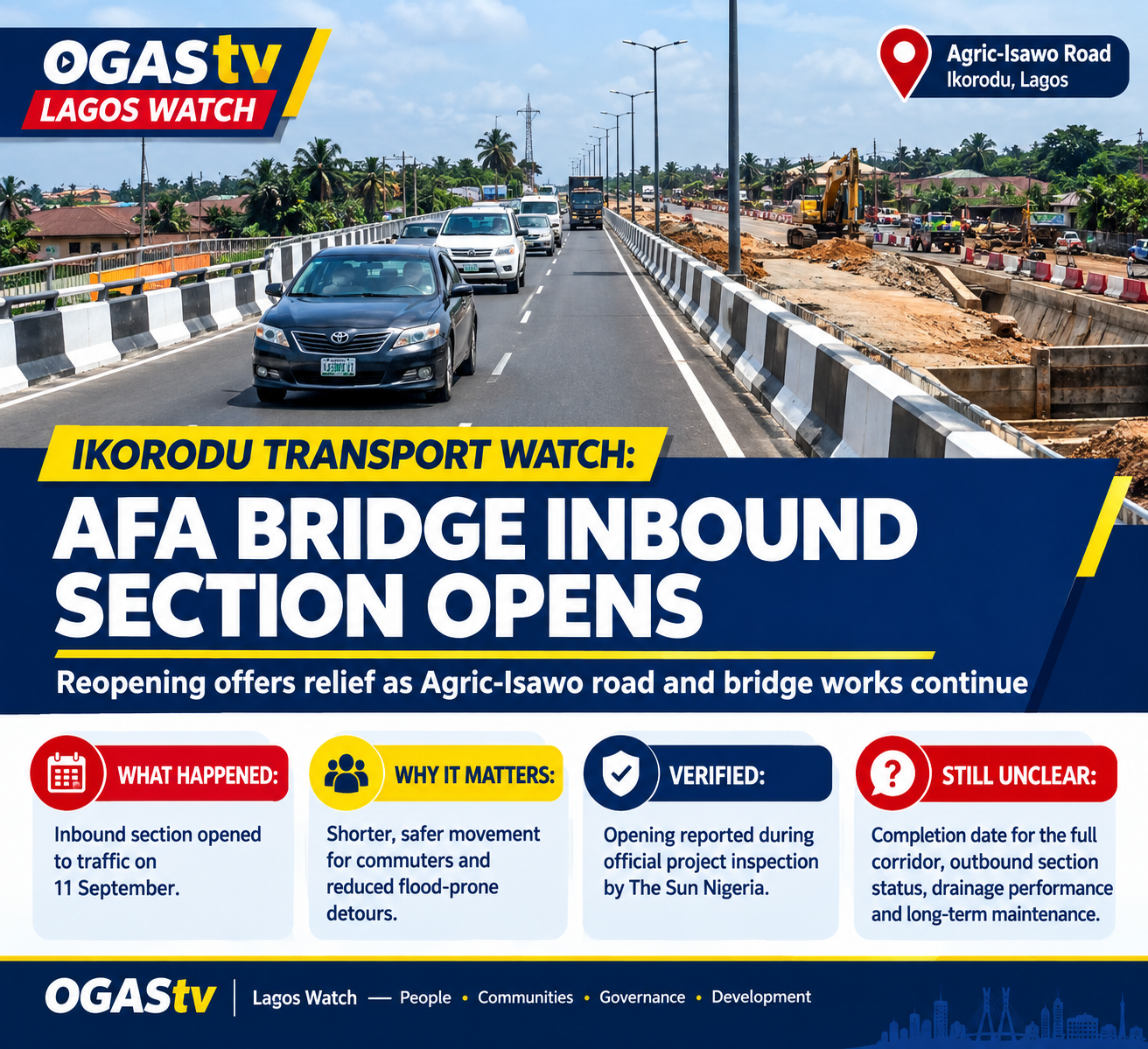
Ikorodu Road Relief: AFA Bridge Reopens One Direction—When Will the Full Agric–Isawo Corridor Be Ready?
OgasTv Ikorodu Transport Watch — AFA Bridge Inbound Section Opens What happened: The inbound section of AFA Bridge on Agric–Isawo Road, Ikorodu, opened to traffic on 11 September 2026 during an inspection of the ongoing Agric–Isawo–Konu–Arepo road and bridge project. Why it matters: The reopening should ease movement for commuters who had been using difficult,…