Nigeria Trade & Industrial Policy Watch — China market-access development.
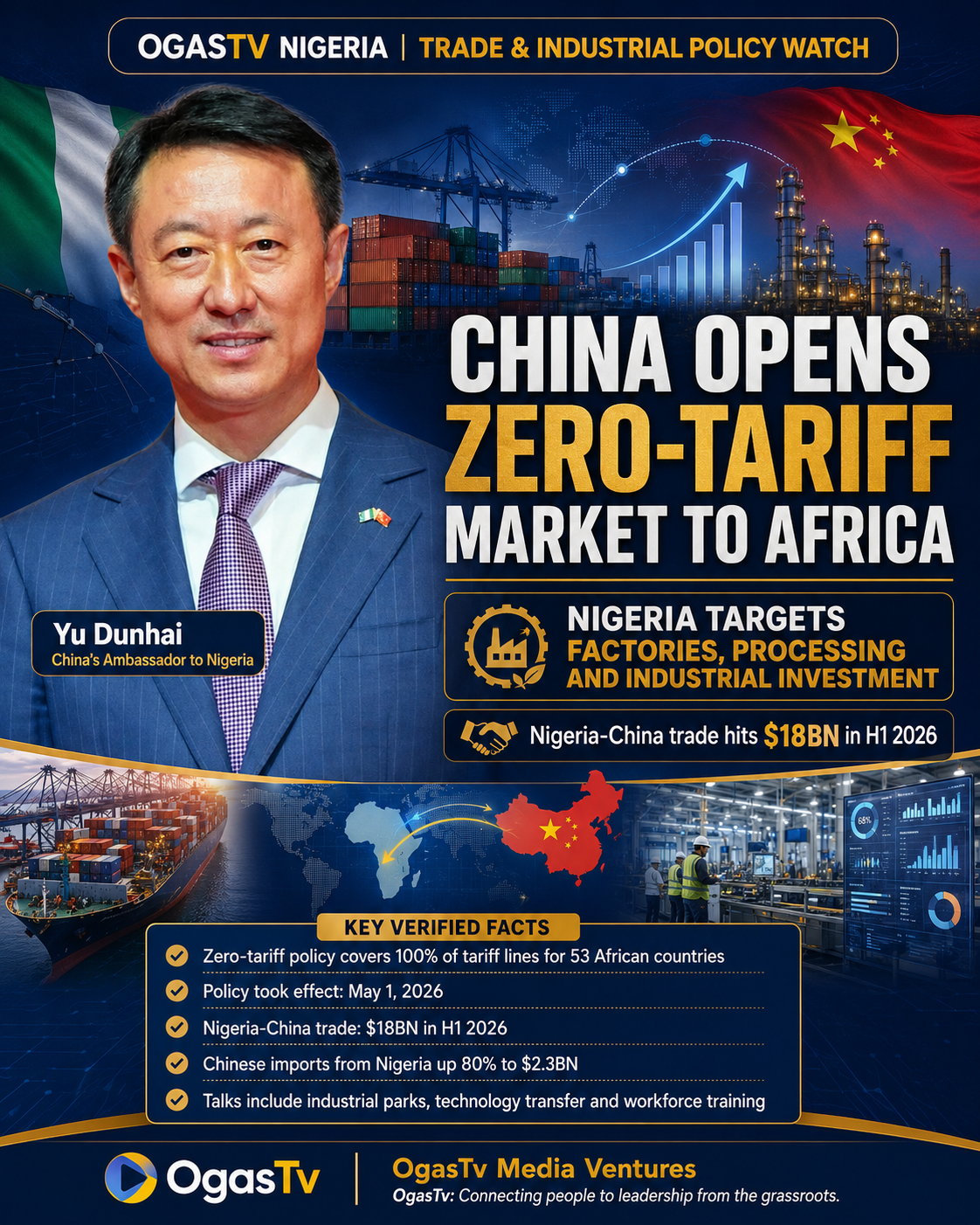
The Federal Government says Nigeria is positioning itself to convert China’s new zero-tariff regime for African countries into an industrialisation and export-processing opportunity, rather than using the policy simply to expand raw-material exports. The development was disclosed in an official Ministry of Foreign Affairs statement issued on Saturday, August 15, 2026, following an Abuja seminar on China’s zero-tariff treatment for African countries.
The material development is the scale of the market opening and the early trade response. China’s ambassador to Nigeria, Yu Dunhai, said the policy took effect on May 1, 2026 and now covers 100% of tariff lines for 53 African countries. He disclosed that Nigeria-China trade reached $18 billion in the first half of 2026, up 35% year-on-year, while Chinese imports from Nigeria rose 80% to $2.3 billion.
Why it matters: Nigeria now has preferential access to a major export market at a time when government policy is increasingly focused on domestic processing, manufacturing and value retention. The immediate opportunity is not merely higher exports; it is whether Nigerian firms can use tariff-free access to justify investment in factories, agro-processing, mineral beneficiation and regional supply chains. The second-order risk is that Nigeria simply increases exports of unprocessed commodities and captures limited additional value locally.
The Chinese side also said it is ready to finalise an Agreement on Economic Partnership for Shared Development with Nigeria and support joint industrial parks, technology transfer and workforce training. That is potentially more consequential than the tariff concession itself because it could turn trade access into productive investment if binding projects and financing follow.
Original/earliest credible source: the Federal Ministry of Foreign Affairs, through spokesperson Kimiebi Imomotimi Ebienfa, with the statement subsequently published by the Federal Ministry of Information and National Orientation on August 15.
Confirmed: China’s zero-tariff treatment is in force; Nigeria-China H1 trade reached $18 billion according to the Chinese ambassador; Chinese imports from Nigeria increased sharply; and both governments are discussing deeper industrial and investment cooperation. Unconfirmed: the value and location of any new industrial parks, specific Nigerian companies or products that will receive investment, the timetable for the proposed economic partnership agreement, and whether the trade surge will translate into significant domestic manufacturing capacity.