
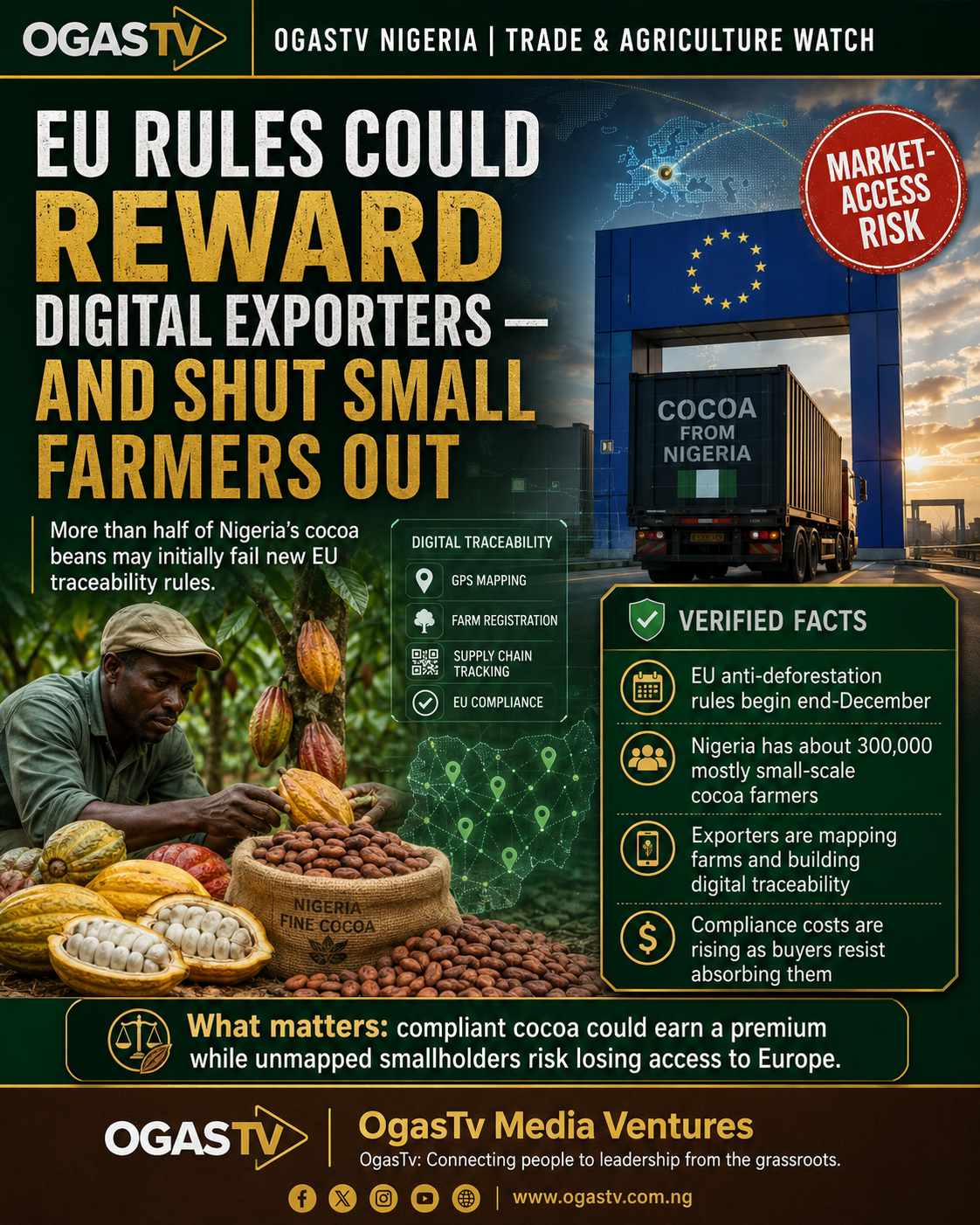
Nigeria Trade & Agriculture Watch — cocoa-export risk.
A new development with direct implications for Nigerian exporters emerged on Monday, August 17, 2026. Reuters reported at 7:02 a.m. UTC / 8:02 a.m. WAT that industry experts expect more than half of Nigeria’s cocoa beans could initially fail to meet the European Union’s new anti-deforestation requirements when enforcement begins at the end of December. Nigeria has roughly 300,000 predominantly small-scale cocoa farmers, according to Nigerian Export Promotion Council data cited in the report.
What changed: the issue has moved from a future regulatory concern to a measurable market-access and compliance problem. Exporters must be able to geolocate farms, demonstrate that cocoa was not produced on recently deforested land, verify legal production and maintain traceable digital records through the supply chain. Reuters reports that Nigerian exporters are already spending substantial amounts to build those systems.
One major exporter, Sunbeth Global, says it has mapped 124,000 hectares covering about 60,000 tonnes of cocoa, spending approximately $30–$70 per tonne on compliance. Starlink Global and Ideal, described by Reuters as Nigeria’s largest cocoa exporter at around 60,000 tonnes annually, reports traceability costs of roughly $40–$80 per tonne. Exporters say European buyers have so far resisted absorbing those additional costs, creating pressure on margins.
Why it matters: Europe is a critical cocoa market, and inadequate traceability could divide Nigeria’s cocoa industry into two tiers — exporters with compliant, digitally traceable supply chains capable of retaining EU access, and smaller farmers or intermediaries whose beans become harder to sell into Europe. Industry specialists expect compliant cocoa to command a premium if supply tightens.
The second-order Nigerian story is industrial. This creates an incentive for government, exporters and processors to accelerate farm mapping, digital traceability, farmer formalisation and domestic cocoa processing. Failure to do so risks excluding thousands of smallholders from premium export markets even if global demand for cocoa remains strong.
Confirmed: the EU deforestation rules are approaching implementation; Nigerian exporters are actively mapping farms and creating traceability systems; leading exporters report material compliance costs; and industry estimates indicate that more than half of Nigerian beans may initially face compliance problems.
Not yet confirmed: exactly what percentage of Nigeria’s 2026/27 crop will ultimately be rejected or redirected from Europe, the resulting price differential between compliant and non-compliant cocoa, whether government will subsidise traceability costs, and how many Nigerian farmers remain completely unmapped.