THE STORY
What Happened — And What the Research Behind It Shows
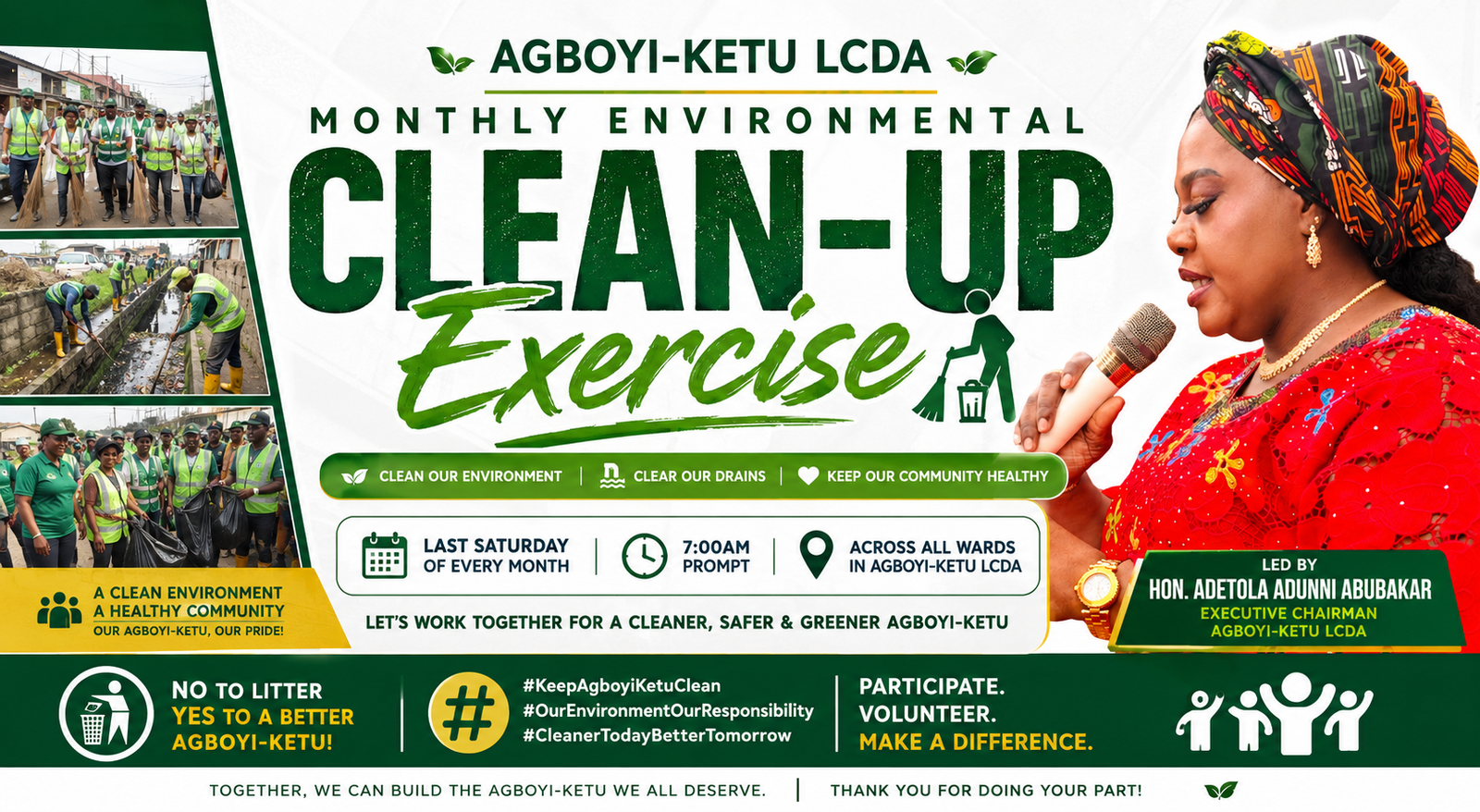
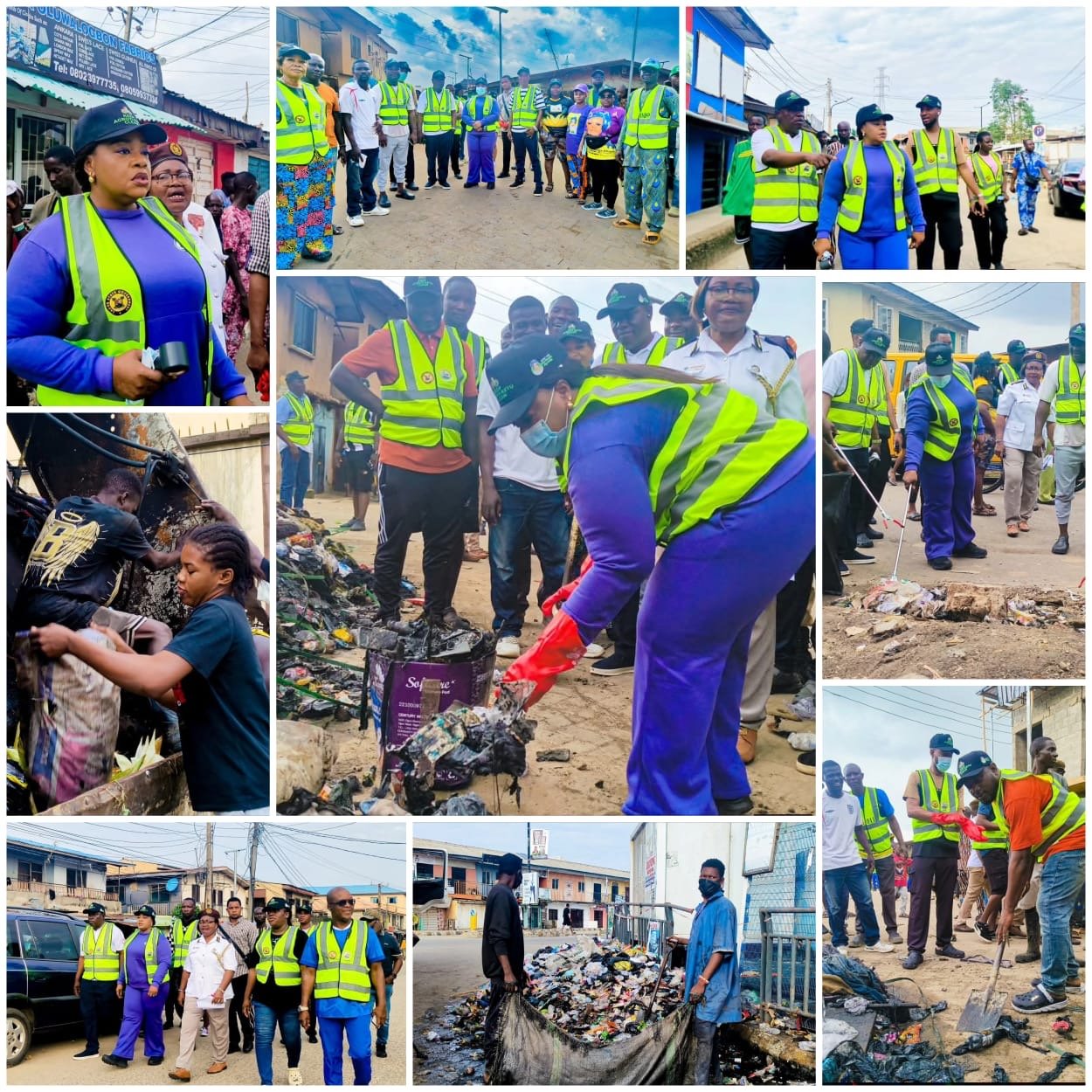
The Executive Chairman’s post, widely shared on social media, described the exercise as reaffirming her administration’s “unwavering commitment to a cleaner, healthier, and more sustainable environment.” According to the LCDA’s own website, residents joined in “good numbers” to clean, clear drains, and organise their surroundings. The Vice Chairman, Secretary to the LGA, Councillors, council management, and party executives all participated.
That kind of visible, participatory leadership matters. In a Lagos where many council chairpersons govern entirely from behind air-conditioned offices, a chairman who physically leads a community exercise sends a meaningful signal. OgasTv notes this as genuine civic leadership — and holds it to the standard it deserves.
“Agboyi-Ketu is perhaps the most unique LCDA in Lagos State in terms of its climate and ecological diversity.”
— HON. ADETOLA ABUBAKAR, CHAIRMAN, AGBOYI-KETU LCDA (MARCH 2026)
That uniqueness, however, is precisely what makes sanitation such a complex challenge here. Agboyi-Ketu is not just an urban community — it includes riverine island communities (Agboyi I, II and III sit on the Lagos Lagoon), creek settlements like Ajegunle-Ikorodu that are highly flood-prone, and dense urban neighbourhoods along major Lagos corridors. A single monthly exercise, however well-intentioned, cannot substitute for the structural environmental interventions this LCDA urgently needs.
A baseline study by the African Cities Research Consortium (ACRC), Rethinking Cities, and the University of Lagos — conducted in 2026 specifically in Agboyi-Ketu — found that waste challenges in the LCDA are closely linked to broader environmental and public health issues, including air pollution and environmental degradation. Economic realities were identified as a key driver: many residents prioritise daily survival needs over waste management compliance.
According to the LCDA’s own Environment Supervisor, Mr. Innocent Osakwe, speaking at an April 2026 community engagement forum, some PSP (Private Sector Participant) operators have reportedly failed to maintain consistent service on assigned routes — returning after months of absence with accumulated charges, a system he criticised as one that punishes residents while rewarding poor service. He also identified funding instability and weak payment systems as systemic challenges. — Source: The Guardian Nigeria, Vanguard, May 2026
Additionally, precipitation levels in Lagos are projected to double by 2050, according to experts at the University of Lagos Centre for Housing and Sustainable Development. For a riverine LCDA like Agboyi-Ketu, this is not a distant climate statistic — it is an immediate governance challenge.
OgasTv Evaluates: What Is Working, What Has Gaps, What Is Urgent
⚠️ Editorial Opinion: The grades below are OgasTv’s independent editorial assessment based on publicly available evidence, official statements, and independent research. They are not official government ratings. See Methodology section below for how grades are determined.
Cleanliness Is Not Just Aesthetics — It Is Public Health, Safety and Economy
FAMILIES
Waterborne diseases spike when drainage fails and potable water is unavailable. Children and elderly residents are most vulnerable. A dirty environment is a health emergency.
TRADERS
Flood-clogged markets and impassable roads directly reduce trader income. During major floods, Agboyi market traders report total business shutdowns that can last weeks.
PROPERTY
Repeated flooding damages homes, walls, and foundations. Insurance is unavailable to most residents. The financial loss accumulates silently year after year.
INVESTMENT
No business wants to set up in a flood-prone, refuse-choked community. Environmental quality directly determines whether Agboyi-Ketu attracts economic activity or repels it.
CLIMATE RISK
With Lagos rainfall projected to double by 2050, today’s flood problem becomes tomorrow’s emergency. Every year of delayed canal and drainage investment makes the future cost higher.
YOUTH
Children in flooded communities miss school, face health risks, and grow up in environments that constrain their possibilities. Environmental neglect is educational neglect.
What This Moment Means — Beyond the Hashtags
OgasTv gives credit where it is due. Hon. Adetola Abubakar has demonstrated visible, participatory leadership. She personally showed up with a broom. She has engaged researchers from the University of Lagos and international partners. She has publicly acknowledged that gaps in waste management exist in her LCDA. These are not small things in a governance environment where many local leaders do none of them.
But the OgasTv standard for civic journalism is not “better than nothing.” It is: are the right things being done, at the right scale, with measurable outcomes? On that measure, Agboyi-Ketu’s environmental challenges remain larger than monthly sanitation exercises can address. The flooding in Agboyi communities is structural — it requires canal infrastructure and drainage investment. The water shortage is systemic — it requires collaboration with the Lagos Water Corporation and Governor’s office. The waste management gap is operational — it requires fixing the PSP operator accountability system and creating community collection points backed by consistent funding.
The question OgasTv puts to the administration is not “are you trying?” — the answer is clearly yes. The question is: what is the measurable 12-month target for each of these three critical issues, and how will residents be able to verify progress?
What Practical Progress Looks Like for Agboyi-Ketu
- INFRASTRUCTUREThe LCDA should publish a concrete timeline for drainage and canal infrastructure in the most flood-affected communities — Agboyi I, II, III and Ajegunle-Ikorodu. Residents have been asking for canals for years. What is the plan and when does construction begin?
- WATERThe LCDA must formally escalate the potable water crisis to the Lagos State Water Corporation and Governor’s office as a health emergency — especially now that rains are intensifying and well contamination risk is at its peak.
- WASTEThe council should implement the community-based waste collection point model piloted with ACRC and Rethinking Cities — starting with the three most underserved wards — and hold PSP operators to enforceable route schedules with publicly posted timetables.
- ACCOUNTABILITYPublish a monthly environmental report on the council website: waste evacuation rates, PSP operator performance, drainage maintenance completed, and flood incidents reported. Transparency builds trust.
- CITIZENSResidents should use community WhatsApp groups and town halls to collectively demand specific answers — not from social media posts, but directly from ward councillors — on drainage timelines, borehole repairs, and PSP schedules.
- YOUTHYoung people in Agboyi-Ketu can apply for the Nigeria Youth Futures Fund (NYFF) Catalyst Grant to lead community-based waste sorting, urban greening, and climate awareness projects in their wards.
What Agboyi-Ketu Residents Can Do This Week
If you live in Agboyi-Ketu — what is the ONE environmental problem that affects your daily life the most: flooding, waste, or water shortage?
DROP YOUR ANSWER IN THE COMMENTS · TAG YOUR COUNCILLOR · SHARE THIS ARTICLE IN YOUR COMMUNITY WHATSAPP GROUP
What OgasTv Verified
Measurable Indicators — June 2026 Baseline
These indicators will be tracked in future editions of this scorecard, allowing residents to measure progress over time. Scores out of 100 are OgasTv editorial estimates based on available evidence.
| INDICATOR | SCORE | BASIS |
|---|---|---|
| Community Participation | 88/100 | Documented resident turnout at sanitation exercises; LCDA and ACRC forum engagement |
| Leadership Visibility | 82/100 | Chairman personally leads exercises; engages UNILAG, ACRC; acknowledges gaps publicly |
| Waste Evacuation | 55/100 | PSP service gaps acknowledged by council; areas with poor road access unserved |
| Transparency & Reporting | 60/100 | Projects listed on council website; no monthly environmental performance data published |
| Water Access | 38/100 | Residents formally petitioned Governor Sanwo-Olu; reliance on boreholes, wells, sachet water |
| Flood Control | 30/100 | Communities cut off by floods annually; canal infrastructure absent; no published drainage timeline |
How OgasTv Governance Scorecards Work
OgasTv Governance Scorecards are independent editorial assessments intended to encourage accountability and informed civic engagement. Scores and grades represent editorial opinions based on publicly available information and field research. They are not official government evaluations.
Grades are determined by evaluating the following criteria over a rolling 12-month period:
- Official government data council announcements, project pages, and statements
- Independent research academic studies, NGO reports, and investigative journalism
- Community interviews documented resident accounts and petitions
- Infrastructure status verified presence or absence of roads, drainage, water, and waste systems
- Progress over previous 12 months evidence of measurable improvement or deterioration
- Leader response whether officials acknowledged issues and provided timelines
Grades:
A = Excellent ·
B = Good progress, gaps remain ·
C = Mixed, significant gaps ·
D = Urgent intervention required ·
F = Critical failure
Future editions of this scorecard will track improvement against this June 2026 baseline. The same methodology will be applied consistently across all LCDAs in the OgasTv Lagos Governance Index.
- Agboyi-Ketu LCDA Official Website — “Strengthening Community Participation Through Environmental Sanitation” (agboyi-ketu.lg.gov.ng)
- The Guardian Nigeria — “New Study Transforms Lagos Community Waste Challenges into Opportunity” (May 4, 2026)
- Vanguard News — “Stakeholders, Others Seek Sustainable Solutions to Waste Management in Lagos” (April 30, 2026)
- The Guardian Nigeria — “Experts Seek Urgent Action in Lagos’ High-Risk Flood-Prone Areas” (March 2, 2026)
- The Nation Newspaper — “Agboyi-Ketu Residents Plead with Sanwo-Olu to Address Water Shortage” (March 25, 2026)
- HEDA Resource Centre — “Agboyi Ketu Community Lagos State” — Flood Documentation
- EnviroNews Nigeria — “Lagos Urged to Address Waste Management Crisis” (June 22, 2026)
- EnviroNews Nigeria — “Residents Demand Lasting Solutions to Lagos Refuse Crisis” (June 19, 2026)
- Lagos Reporters — “Breaking: Local Councils Leading and Lagging Behind in Environmental Sanitation Across Lagos State” (March 2026)
- Nigeria Housing Market — “Local Government in Lagos: Full List of 20 LGAs & 37 LCDAs (2026 Guide)” (March 2026)
- University of Lagos, CHSD — Action Research for Climate Resilience, Agboyi-Ketu LCDA (2026)