The Osun State governorship election has entered its decisive results phase, with the Independent National Electoral Commission, INEC, formally conducting state-level collation in Osogbo after an earlier interruption to uploads on its IReV result-viewing platform.
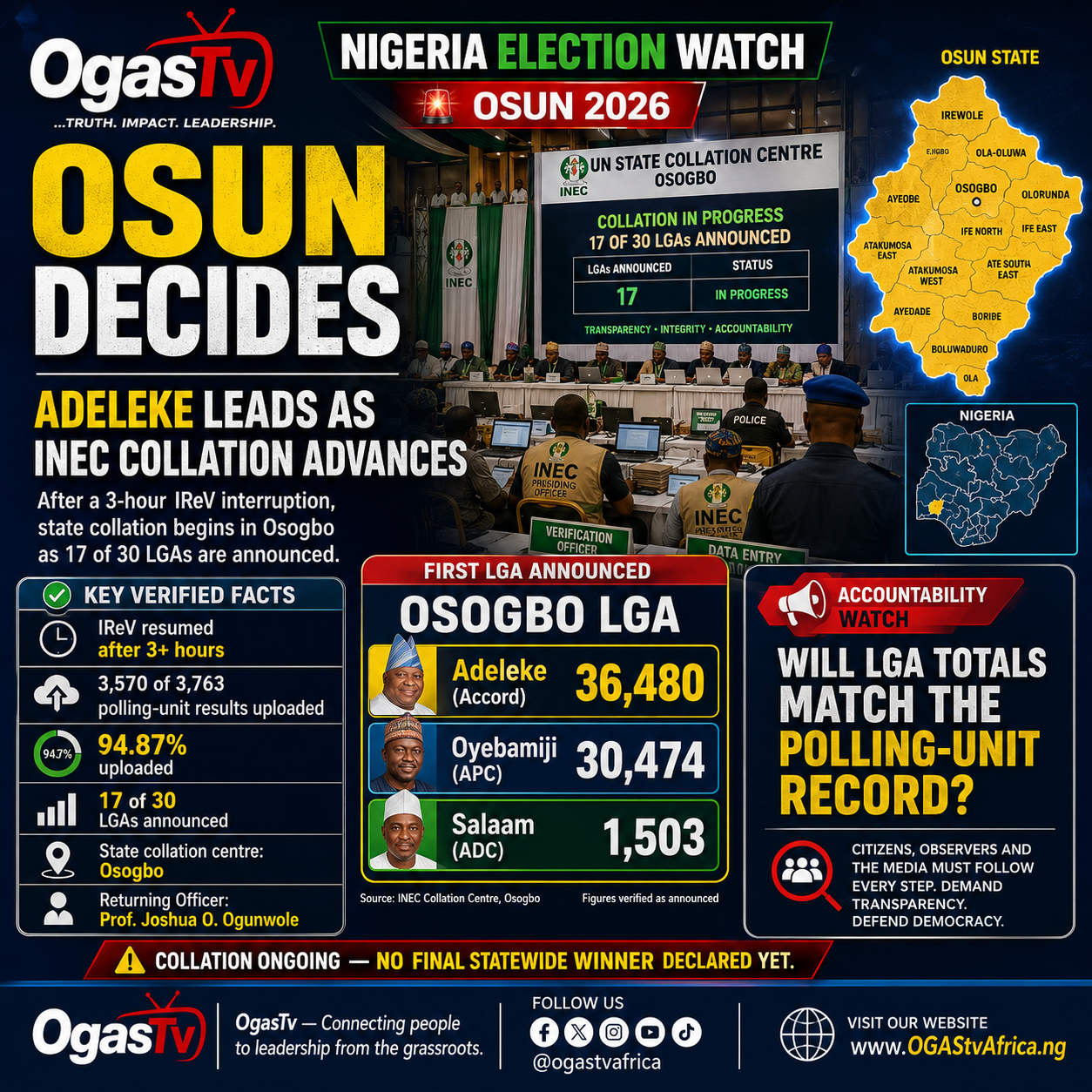
By the early hours of Sunday, August 16, 2026, results from 17 of Osun State’s 30 local government areas had been formally announced at the state collation centre, with incumbent Governor Ademola Adeleke of Accord holding the lead at that stage.
The development marks a significant progression from the voting and polling-unit upload phase into the statutory collation process that will determine the official statewide result.
IReV Uploads Resume After More Than Three Hours
Before state collation commenced, attention had focused heavily on INEC’s IReV platform after polling-unit result uploads stopped for more than three hours.
Uploads had reached 3,292 of 3,763 polling units — 87.48% — at 8:48:08 p.m. on Saturday, August 15, before remaining unchanged for several hours.
A subsequent check at approximately 10:30 p.m. still showed no movement.
The upload process eventually resumed after midnight, with the number rising to 3,570 of 3,763 polling units, representing 94.87%, by approximately 12:20 a.m. on August 16.
The interruption drew political attention because IReV has become an important transparency tool for voters, political parties, journalists and election observers seeking to compare polling-unit records against figures later announced during collation.
However, the IReV portal itself is not the statutory mechanism for declaring the winner of the election.
Political Tension During the IReV Pause
The interruption triggered concern from Governor Adeleke and his campaign.
Adeleke publicly called on President Bola Tinubu and security agencies to ensure that the electoral process was not compromised.
His campaign also alleged that there was an attempt to force the election into an inconclusive outcome.
Those claims remain political allegations.
At the time of this report, there is no verified evidence establishing that the IReV interruption resulted from deliberate manipulation or political interference.
INEC has also not publicly established the technical or operational reason for the three-hour pause.
That explanation remains one of the key accountability issues arising from the election.
State-Level Collation Begins in Osogbo
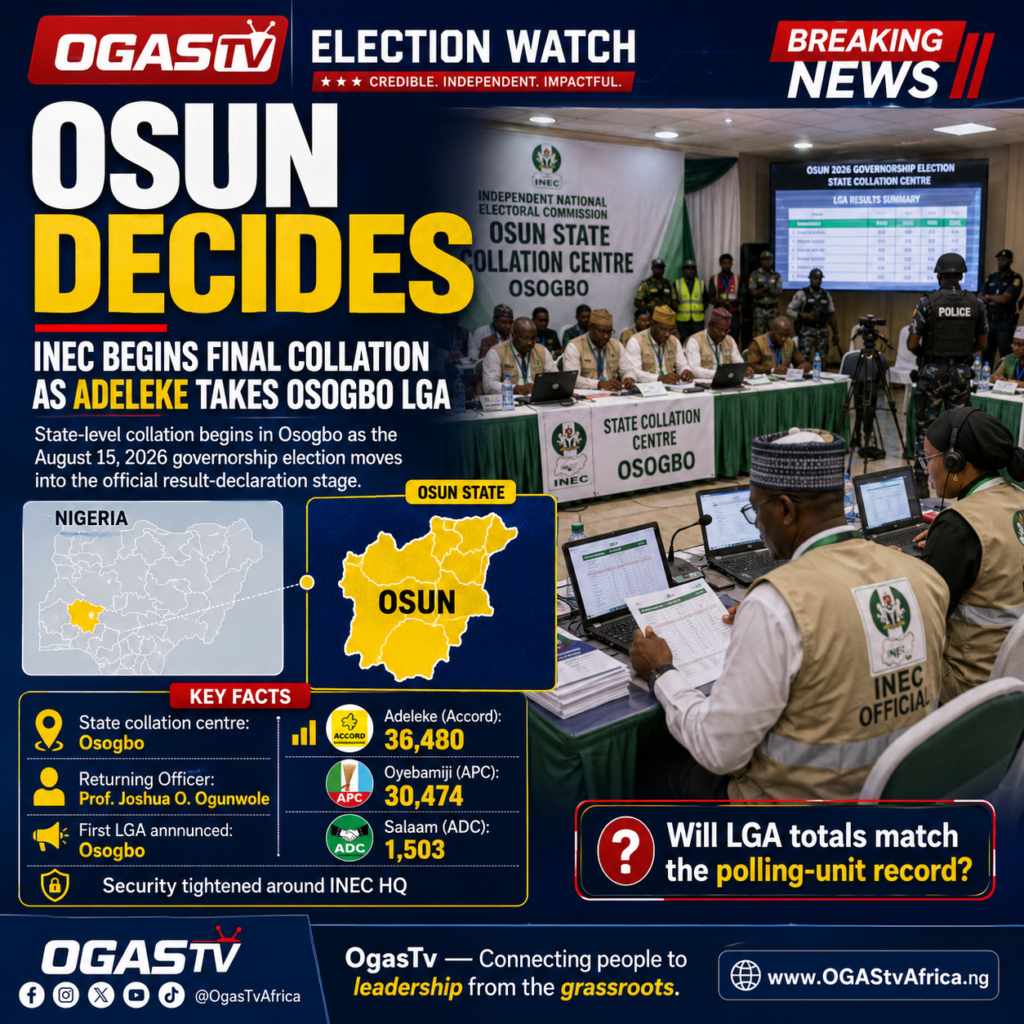
INEC subsequently commenced the formal state collation process at its Osun State headquarters in Osogbo.
The exercise is being conducted in the presence of political party agents, election observers, journalists and security personnel.
The Returning Officer is Professor Joshua Olalekan Ogunwole, Vice-Chancellor of the Federal University Oye-Ekiti.
Security around the INEC headquarters was tightened as the collation process began, with police and military personnel deployed around the venue.
The beginning of state collation shifts the election into its legally decisive phase.
Polling-unit results and IReV uploads provide transparency, but the official outcome will emerge through the formal collation process conducted under the authority of the Returning Officer.
Adeleke Takes Osogbo LGA
The first major LGA result announced from the state collation centre showed Adeleke winning Osogbo Local Government Area.
The figures announced were:
Ademola Adeleke — Accord: 36,480 votes
Bola Oyebamiji — APC: 30,474 votes
Najeem Salaam — ADC: 1,503 votes
The Osogbo result gave Adeleke an early advantage, but one local government result alone could not establish the statewide outcome.
The more significant development came as results from additional LGAs were presented.
Results From 17 LGAs Now Announced
By approximately 4:35 a.m. on Sunday, INEC had announced results from 17 of the state’s 30 LGAs.
Adeleke was leading at that stage.
Accord had recorded victories in several LGAs, including:
- Ede North
- Ede South
- Ife Central
- Ife East
- Ife North
- Ifedayo
- Ifelodun
- Ila
- Ilesa West
- Iwo
- Odo Otin
- Oriade
- Orolu
- Osogbo
APC had also secured victories in several LGAs, including:
- Atakunmosa East
- Atakunmosa West
- Boripe
- Ilesa East
- Irepodun
- Irewole
- Obokun
As collation continues, the central political question is whether Adeleke’s lead can survive the remaining local government results.
Why This Stage Matters
The election has now crossed the halfway point in formal LGA collation.
That changes the nature of the contest.
Earlier in the day, the major concerns centred on voting logistics, BVAS performance, isolated violence, allegations of vote-buying and the pace of IReV uploads.
Now the central issue is mathematical and procedural consistency.
The question is whether the figures announced from each LGA reconcile with the underlying polling-unit and ward records.
That is the strongest test of the integrity of the result chain.
The OgasTv Accountability Test
For OgasTv, the critical issue is no longer merely whether Adeleke or Oyebamiji is ahead.
The deeper question is whether the entire results process can be independently traced from:
Polling unit → Ward → LGA → State collation → Final declaration
Each stage must reconcile with the previous one.
Any unexplained discrepancy between polling-unit records and later LGA figures would require scrutiny.
Similarly, the earlier three-hour IReV interruption remains relevant because INEC should ultimately provide a clear explanation of what caused the pause and whether any data integrity issue occurred.
What Is Confirmed
As of the latest stage covered in this report:
- IReV uploads resumed after an interruption lasting more than three hours.
- 3,570 of 3,763 polling-unit results had been uploaded, representing 94.87%.
- State-level collation has formally commenced in Osogbo.
- Professor Joshua Olalekan Ogunwole is serving as Returning Officer.
- Osogbo LGA was won by Adeleke.
- Results from 17 LGAs had been formally announced.
- Adeleke was leading at that stage.
- Security around the state collation centre had been strengthened.
What Remains Unconfirmed
Several issues remain unresolved:
- the final statewide vote totals;
- the eventual winner of the governorship election;
- how many LGAs each candidate will ultimately win;
- whether formal objections or discrepancies will emerge during collation;
- the reason for the earlier IReV interruption;
- whether INEC will issue an official technical explanation for the pause.
Until the Returning Officer completes the process and formally declares the winner, any statewide victory claim remains premature.
What Happens Next
The remaining 13 LGAs are now critical.
If Adeleke maintains a sufficiently large lead as those results are presented, the election could move quickly toward a final declaration.
If APC closes the gap significantly, the final LGAs could become decisive.
The most important issue for election credibility, however, will remain the same regardless of who wins:
Do the LGA results match the polling-unit record?
Osun has repeatedly been framed as a test of Nigeria’s electoral institutions ahead of 2027.
That test will ultimately be judged not only by the identity of the winner, but by whether INEC can demonstrate a result chain that is transparent, internally consistent and capable of withstanding public and legal scrutiny.
OgasTv Africa — Connecting people to leadership from the grassroots.