
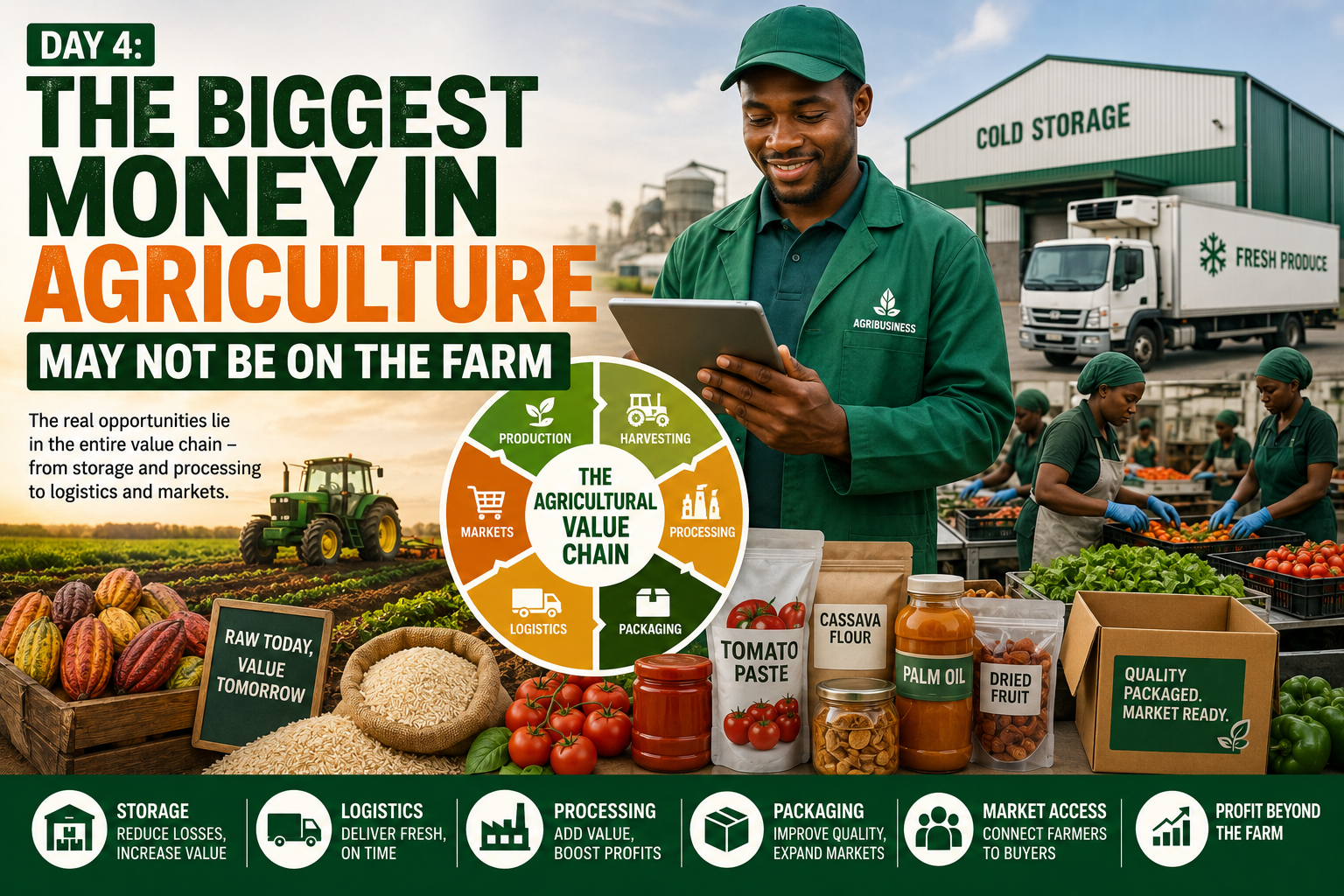
When most people think about investing in agriculture, the first idea that comes to mind is buying farmland.
The advice is familiar: acquire land, plant crops, wait for harvest and sell.
But what if the biggest business opportunities in Nigeria’s agricultural sector are not on the farm at all?
Agriculture is far more than cultivation. It is an interconnected value chain that begins long before a seed is planted and continues long after a crop leaves the field. Along that journey are countless challenges—many of which present profitable opportunities for entrepreneurs willing to solve them.
For aspiring investors, the more important question may not be, “What should I grow?” but rather, “What problem in the agricultural value chain can I solve?”
Key Takeaways
- Farming is only one part of Nigeria’s agricultural economy.
- Significant business opportunities exist in processing, storage, logistics and distribution.
- Value addition often generates higher returns than selling raw agricultural produce.
- Entrepreneurs should identify buyers before investing in production.
- Solving inefficiencies within the agricultural value chain can create sustainable businesses.
Understanding Nigeria’s Agricultural Value Chain
Before food reaches consumers, it passes through several stages.
These include:
- Production
- Harvesting
- Aggregation
- Storage
- Transportation
- Processing
- Packaging
- Distribution
- Retail
Each stage requires specialised services.
While farmers remain the backbone of food production, they depend on many other businesses to ensure their products reach consumers safely and profitably.
For example:
- Who stores harvested tomatoes before they spoil?
- Who transports fresh vegetables from rural communities to urban markets?
- Who processes cassava into garri, flour or industrial starch?
- Who packages grains for supermarkets?
- Who finances farmers during planting season?
- Who connects producers with reliable buyers?
Every unanswered question represents a potential business opportunity.
The Real Problem Isn’t Always Production
Nigeria is one of Africa’s largest agricultural producers, yet farmers continue to face significant post-harvest losses.
Poor storage facilities, weak transport networks, inadequate processing capacity and inconsistent electricity supply often reduce the value of agricultural products before they reach the market.
According to the Food and Agriculture Organization (FAO), improving post-harvest handling and value addition remains essential to reducing food losses and strengthening food security across developing economies.
For many farmers, the challenge is not producing more—it is preserving, processing and marketing what has already been produced.
Where the Biggest Opportunities Exist
Entrepreneurs do not necessarily need to become farmers to succeed in agriculture.
Some of the fastest-growing opportunities include:
Food Processing
Turning raw agricultural products into finished goods creates significantly more value.
Examples include:
- Cassava into garri, flour or starch
- Cocoa into chocolate and cocoa butter
- Tomatoes into paste
- Fruits into juice or dried snacks
- Maize into animal feed
Processing extends shelf life while increasing profitability.
Cold Storage
Fresh produce such as tomatoes, vegetables, fruits and fish can spoil quickly without refrigeration.
Cold rooms and refrigerated warehouses help farmers reduce losses while supplying markets throughout the year.
Solar-powered cold storage solutions are becoming increasingly attractive in areas with unreliable electricity.
Agricultural Logistics
Transport remains one of Nigeria’s biggest agricultural challenges.
Businesses providing:
- Refrigerated trucks
- Produce haulage
- Last-mile delivery
- Farm-to-market logistics
play an essential role in reducing waste and improving market access.
Commodity Aggregation
Many supermarkets, processors and exporters require large volumes of produce from multiple farmers.
Commodity aggregators bridge this gap by purchasing from numerous smallholder farmers before supplying larger buyers.
Equipment Leasing
Agricultural machinery is expensive.
Instead of purchasing tractors or harvesters, many farmers prefer renting equipment during planting and harvesting seasons.
Equipment leasing businesses can generate recurring income while improving farm productivity.
Packaging and Branding
Quality packaging does more than protect products—it increases consumer confidence and helps businesses access supermarkets and export markets.
Entrepreneurs offering packaging, labelling and branding services are supporting the growth of Nigeria’s food industry.
Agricultural Technology
Digital innovation is transforming agriculture.
Technology businesses can provide:
- Market information
- Digital marketplaces
- Farm management software
- Supply chain tracking
- Produce traceability
- Payment solutions
These services help improve efficiency throughout the agricultural value chain.
Why Value Addition Matters
One of Nigeria’s biggest economic challenges is exporting raw commodities instead of processed products.
Raw products generally command lower prices than finished goods.
Consider the difference:
A farmer sells raw cassava.
A processor converts the same cassava into garri, industrial starch or high-quality flour.
Each stage of processing creates additional value, supports manufacturing and generates employment.
The same principle applies to cocoa, cashew, sesame, ginger, palm oil and many other agricultural commodities.
Recent government initiatives aimed at strengthening local cocoa processing reflect growing recognition that value addition can increase export earnings and stimulate industrial development. The long-term impact, however, will depend on effective implementation, investment and private-sector participation.
Start With the Market, Not the Farm
One of the most common mistakes new investors make is producing first and searching for buyers later.
Successful agribusinesses often reverse the process.
Before investing, entrepreneurs should understand:
- Who will buy the product?
- What quality standards are required?
- How much are buyers willing to pay?
- What are the transportation costs?
- How long can the product be stored?
- What licences or certifications are required?
- How much working capital will be needed?
Building around confirmed demand reduces business risk.
Potential Buyers to Target
Depending on the product, customers may include:
- Supermarkets
- Hotels
- Restaurants
- Food processors
- Exporters
- Schools
- Hospitals
- Commodity merchants
- Manufacturers
- Institutional buyers
Long-term supply agreements often provide greater stability than relying solely on open markets.
Opportunities for Small Investors
Starting an agribusiness does not always require owning hundreds of hectares of farmland or building a large factory.
Small-scale opportunities include:
- Operating a solar-powered cold room
- Aggregating produce for supermarkets
- Leasing tractors or irrigation equipment
- Packaging grains for urban consumers
- Processing cassava into garri
- Providing transport for farming clusters
- Supplying farm inputs
- Connecting farmers with processors through digital platforms
By solving one recurring problem effectively, entrepreneurs can build profitable businesses without controlling the entire agricultural value chain.
Challenges to Consider
Like every business, agribusiness carries risks.
Potential investors should consider:
- Seasonal price fluctuations
- Poor road infrastructure
- Security concerns
- Access to finance
- Regulatory requirements
- Product quality standards
- Climate-related risks
- Storage costs
Conducting proper market research before investing is essential.
Conclusion
The future of agriculture in Nigeria will not belong exclusively to those who own the largest farms.
It will also belong to entrepreneurs who solve the problems that exist between the farm and the final consumer.
Whether through food processing, logistics, cold storage, packaging, equipment leasing or digital innovation, every gap in the agricultural value chain represents a potential business opportunity.
Before investing in agriculture, ask yourself one important question:
“What expensive problem can I solve repeatedly and profitably?”
The answer may lead to a stronger and more sustainable business than farming alone.
Frequently Asked Questions
Can I invest in agriculture without owning farmland?
Yes. Businesses in food processing, logistics, cold storage, packaging, equipment leasing and agricultural technology allow entrepreneurs to participate without owning farmland.
What is value addition in agriculture?
Value addition involves processing or improving raw agricultural products to increase their market value, such as turning cassava into garri or cocoa beans into chocolate.
Which agribusiness has high potential in Nigeria?
Promising opportunities include food processing, cold-chain logistics, commodity aggregation, farm equipment leasing, packaging, digital agriculture and agricultural warehousing.
Why do farmers lose money after harvest?
Many losses occur because of poor storage, inadequate transportation, weak market access and limited processing facilities, leading to spoilage and lower selling prices.