
Category: Business | Energy | Economy
By OGAsTV Editorial
Published: July 2026
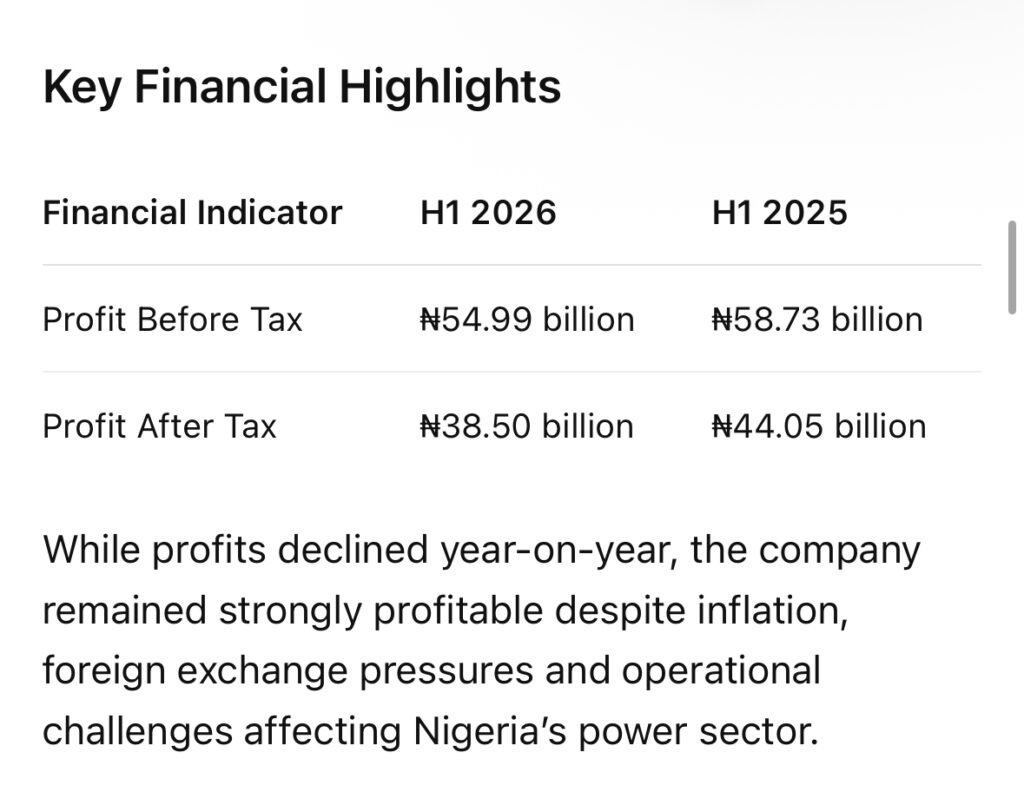
Transcorp Power Plc has reported a Profit After Tax (PAT) of ₦38.5 billion for the first half (H1) of 2026, according to its unaudited financial results released on the Nigerian Exchange Limited (NGX). Although this represents a decline from the ₦44.05 billion recorded during the same period in 2025, the company remains one of Nigeria’s strongest-performing power generation firms.
The company also posted a Profit Before Tax (PBT) of ₦54.99 billion, compared to ₦58.73 billion in H1 2025.
Beyond the numbers, Transcorp Power’s performance highlights the growing importance of private-sector investment in solving one of Nigeria’s biggest challenges—reliable electricity.
Why Transcorp Power Matters
Transcorp Power Plc is a subsidiary of Transnational Corporation Plc (Transcorp Group), one of Africa’s leading listed conglomerates with investments in power generation, hospitality and energy.
Its role extends beyond generating profits for shareholders. It is one of the independent power producers helping to supply electricity to Nigeria’s national grid, making it a key player in the country’s economic development.
What This Means for Nigeria
1. Greater Confidence in Private Investment
Consistent profitability demonstrates that private investment in electricity generation can be commercially viable when supported by the right policies.
This could encourage more local and international investors to commit capital to Nigeria’s energy sector, leading to increased electricity generation and improved infrastructure.
2. More Reliable Power Supply
As companies like Transcorp Power expand their operations and invest in new technologies, businesses and households stand to benefit from improved electricity supply.
Reliable power reduces dependence on diesel generators, lowers operating costs and improves productivity across industries.
3. Job Creation
The growth of the power sector creates employment opportunities in:
- Engineering
- Construction
- Plant operations
- Information technology
- Environmental management
- Equipment maintenance
- Project management
Indirectly, better electricity also supports thousands of jobs in manufacturing, agriculture, healthcare and education.
4. Industrial Growth
Electricity remains one of the biggest barriers to industrial development in Nigeria.
Improved power generation can help manufacturers reduce production costs, increase output and compete more effectively in regional and global markets.
Small and medium-sized enterprises (SMEs), which form the backbone of Nigeria’s economy, also benefit from stable electricity through lower operating expenses and higher productivity.
5. Economic Growth
Reliable electricity is closely linked to Gross Domestic Product (GDP) growth.
Better power supply can stimulate:
- Manufacturing
- Agriculture
- Digital services
- Mining
- Healthcare
- Education
- Financial services
Ultimately, this contributes to higher national productivity and improved living standards.
Why This Matters for Africa
Strengthening Regional Energy Investment
Nigeria is Africa’s largest economy and one of its biggest electricity markets.
Successful private power companies can serve as models for other African countries seeking to attract investment into their energy sectors.
Countries such as Ghana, Kenya, Tanzania and Côte d’Ivoire are also expanding private-sector participation in electricity generation.
Supporting the African Continental Free Trade Area (AfCFTA)
The African Continental Free Trade Area (AfCFTA) aims to increase trade among African countries.
However, manufacturing and industrialisation depend heavily on reliable electricity.
A stronger Nigerian power sector could improve the country’s competitiveness while supporting regional trade and industrial cooperation.
Encouraging Innovation
Private power companies increasingly invest in:
- Digital monitoring systems
- Smart energy management
- Grid modernisation
- Cleaner energy technologies
- Operational efficiency
These innovations contribute to the long-term sustainability of Africa’s energy infrastructure.
Challenges Remain
Despite encouraging financial performance, Nigeria’s power sector continues to face significant obstacles.
These include:
- Transmission constraints
- Gas supply disruptions
- Foreign exchange volatility
- Electricity market debts
- Infrastructure deficits
- Grid reliability challenges
Addressing these issues will require stronger collaboration between government, regulators and private investors.
The Bigger Picture
Transcorp Power’s H1 2026 results demonstrate that profitability and infrastructure development can go hand in hand.
While the decline in year-on-year earnings reflects broader economic pressures, the company’s ability to remain profitable signals resilience in a challenging operating environment.
As Nigeria seeks to expand electricity access, attract investment and drive industrialisation, financially stable power companies will play an increasingly important role in achieving those goals.
Conclusion
Transcorp Power’s financial performance is more than a corporate earnings report—it reflects the growing role of private enterprise in shaping Nigeria’s energy future.
For Nigeria, continued investment in power generation could lead to improved electricity supply, increased industrial output, more jobs and stronger economic growth.
For Africa, successful energy companies provide valuable examples of how private-sector participation can support infrastructure development and accelerate economic transformation.
The road to stable electricity across the continent remains challenging, but sustained investment, effective regulation and innovation will be essential to powering Africa’s next phase of growth.
Frequently Asked Questions (FAQs)
What profit did Transcorp Power report in H1 2026?
The company reported a Profit After Tax of ₦38.5 billion and a Profit Before Tax of ₦54.99 billion for the first half of 2026.
Why did profits decline?
The financial statement indicates lower year-on-year profits compared with H1 2025. A detailed explanation would typically be found in the company’s full financial disclosures and management commentary.
Why is Transcorp Power important to Nigeria?
The company contributes to electricity generation, supports economic growth, attracts investment and plays a significant role in Nigeria’s power sector.
How does a stronger power sector benefit Africa?
Improved electricity generation supports industrialisation, trade, job creation and economic development across the continent.