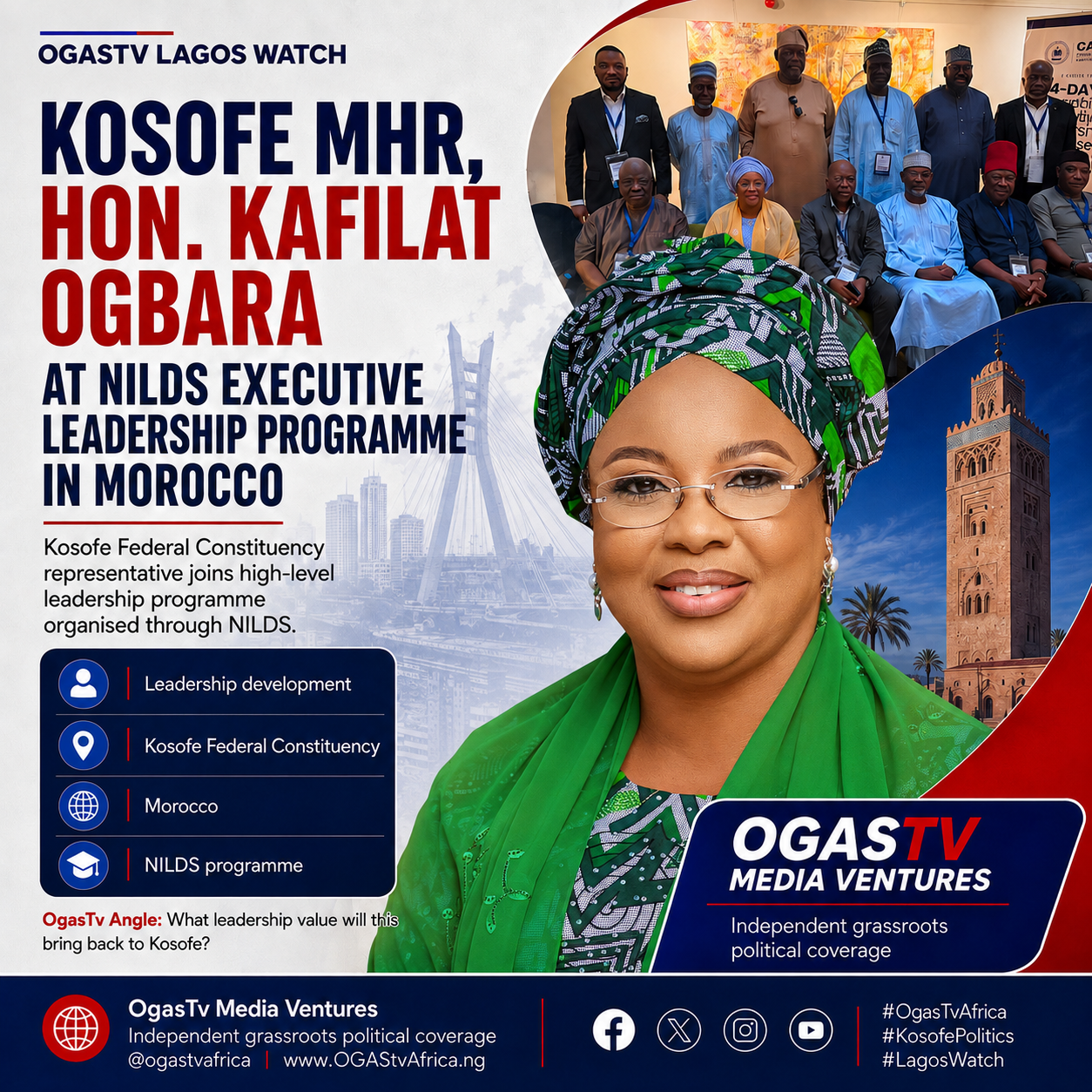
Hon. Kafilat Ogbara, Member of the House of Representatives representing Kosofe Federal Constituency, has participated in a high-level International Executive Leadership Course organised by the National Institute for Legislative and Democratic Studies, NILDS, in Marrakech, Morocco.
The four-day programme was organised for members of the NILDS Governing Council through the Institute’s Centre for Advanced Executive Education Programme, CAEEP. (X (formerly Twitter))
The programme was held under the theme:
“Strategic Leadership and Institutional Readiness for Legislative Excellence: Interrogating Topical Issues on Nigeria’s Democratic Development.” (ThisDayLive)
For Ogbara, who represents Kosofe Federal Constituency in the National Assembly, participation places her within a broader institutional conversation around strengthening legislative leadership, democratic institutions and the capacity of lawmakers to respond to increasingly complex governance challenges.
Beyond a Leadership Retreat
The Marrakech programme focused on strategic leadership and the preparedness of Nigeria’s legislative institutions to respond to changing political, technological and governance realities.
Director-General of NILDS, Professor Abubakar O. Sulaiman, said institutions must increasingly move beyond reactive leadership and develop the capacity to anticipate change, strengthen institutional memory and adapt to emerging challenges.
Among the issues identified as reshaping the environment in which democratic institutions operate are rapid technological advancement, growing public demands for accountability, security challenges and the increasing influence of artificial intelligence.
The NILDS leadership argued that legislative institutions therefore require stronger professionalism, continuous capacity development, innovation, effective public engagement and greater use of technology.
Preparing Nigeria’s Legislature Ahead of 2027
The programme also carries significance as Nigeria approaches the 2027 general elections.
According to NILDS, institutional preparation cannot begin only after elections have taken place. The Institute is expected to play a major role in preparing and orientating newly elected legislators, preserving institutional knowledge and strengthening understanding of parliamentary procedures, legislative processes, oversight responsibilities and Nigeria’s constitutional framework.
NILDS Director-General Professor Sulaiman consequently stressed that institutional readiness requires foresight, planning, coordination and strategic leadership.
That gives the Marrakech programme a broader objective than conventional political training: strengthening the institutional architecture surrounding Nigeria’s National Assembly before another electoral transition.
High-Level Participation
The programme brought together members of the National Assembly and other stakeholders, with resource persons from Nigeria and abroad discussing governance, democracy, legislative development and institutional leadership.
Reported resource persons included Deputy Secretary-General of the United Nations Amina J. Mohammed, former Independent National Electoral Commission Chairman Professor Attahiru Jega, Nigeria’s Ambassador to Germany Senator Ita Enang and Professor Zakaria Garno of Euromed University.
Senate President Godswill Akpabio, Chairman of the NILDS Governing Council, was represented at the programme by Senator Victor Umeh. Akpabio urged participants to use the opportunity for strategic reflection and to develop practical ideas capable of strengthening Nigerian institutions and addressing national development challenges. (News Agency of Nigeria)
What It Means for Kosofe
For residents of Kosofe Federal Constituency, Hon. Kafilat Ogbara’s participation should ultimately be assessed beyond attendance at an international leadership programme.
The more important questions are what institutional knowledge is brought back to the constituency and whether that knowledge translates into stronger legislative representation, more effective oversight, deeper constituency engagement and measurable policy outcomes.
Executive training becomes most valuable to constituents when the experience improves how their representative performs the core functions of lawmaking, representation and oversight.
For OgasTv Kosofe Watch, this therefore creates a useful follow-up benchmark.
The questions to watch include:
What legislative or governance ideas will Ogbara take from the programme?
Will the experience influence her committee work or legislative priorities?
Can any of the institutional lessons strengthen how her constituency office engages residents and tracks community needs?
And as Nigeria moves toward the 2027 election cycle, how will enhanced legislative capacity translate into measurable outcomes for Kosofe?
Ogbara’s presence at the Marrakech programme represents a positive leadership-development development, but the stronger grassroots story will be what happens after the programme.
For Kosofe residents, the ultimate measure remains impact at home.
OgasTv Kosofe Watch — Connecting the People to Leadership.