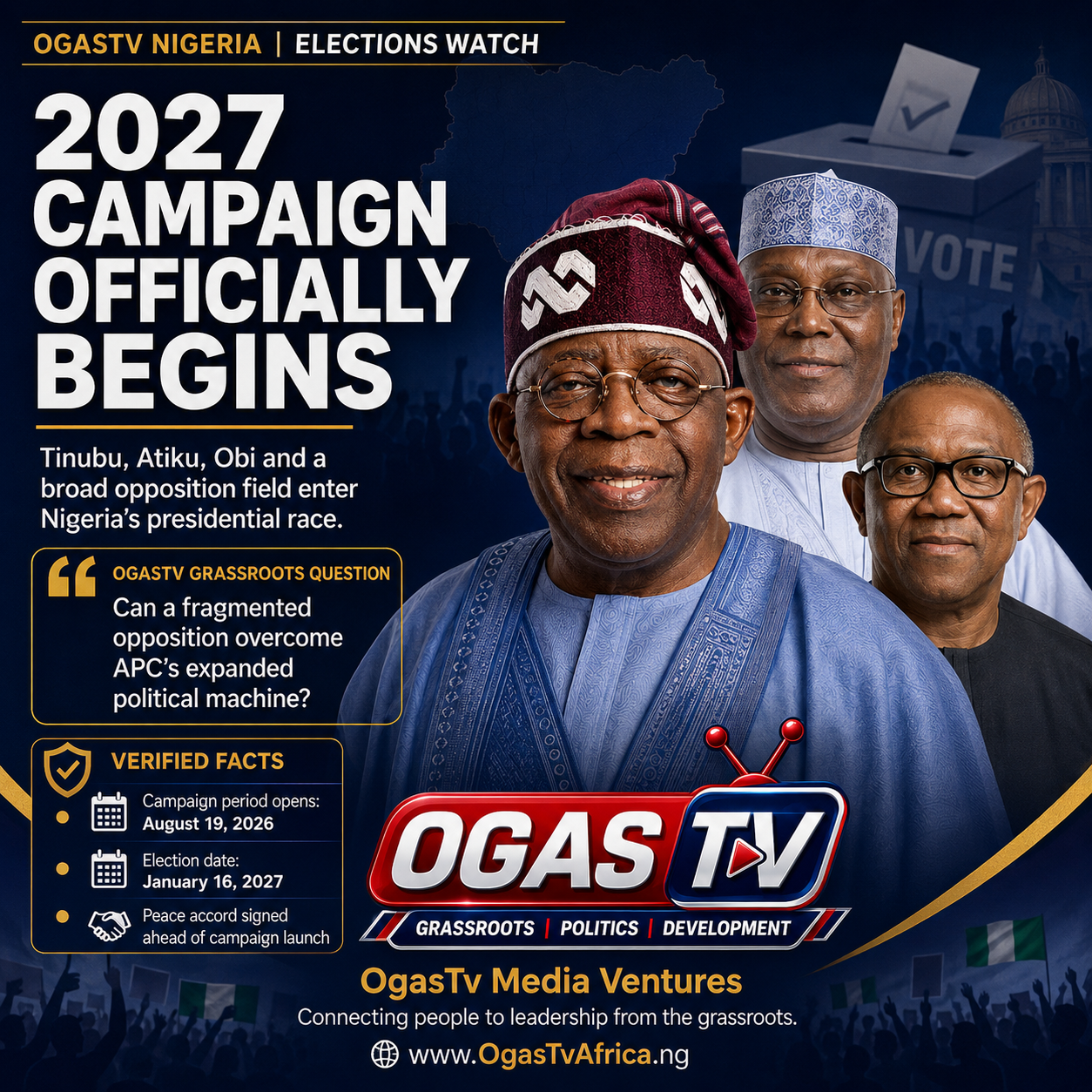
Nigeria has formally entered the 2027 presidential campaign season, with the regulated campaign period for the January 16, 2027 presidential and National Assembly elections beginning on Wednesday, August 19, 2026.
The development marks a clear shift from months of political positioning, defections, coalition-building and internal party manoeuvring into the formal contest for the Nigerian electorate.
President Bola Ahmed Tinubu is seeking re-election, while former Vice President Atiku Abubakar of the ADC and Peter Obi of the Nigeria Democratic Congress are among the major opposition figures entering the race.
With a wide field of opposition candidates, one of the defining questions at the start of the campaign is whether opposition fragmentation will strengthen the incumbent’s advantage or whether political realignments could still emerge before Nigerians vote.
From Political Positioning to Direct Voter Mobilisation
Until now, much of Nigeria’s 2027 political activity has centred on party structures, endorsements, defections, alliances and internal negotiations.
That phase is changing.
The opening of the official campaign period means political parties and candidates can now move more aggressively into direct voter mobilisation through rallies, advertising, media appearances, policy messaging, grassroots organisation and nationwide campaign structures.
For voters, this should also mark the beginning of greater scrutiny of what each candidate is actually offering.
The conversation should increasingly move from personality and political calculations toward measurable commitments on the economy, security, jobs, infrastructure, education, healthcare, energy, governance and institutional reform.
Tinubu Enters the Race With an Expanded Political Machine
President Tinubu enters the campaign as an incumbent with the structural advantages that come with controlling the federal government and leading the APC.
The party has also strengthened its political presence across several states ahead of the election cycle.
That gives the President an established network of governors, party executives, legislators, local government structures and grassroots organisers capable of supporting nationwide mobilisation.
But incumbency also comes with a different burden.
The election will effectively become a referendum on the administration’s performance.
Economic reforms, inflation, household purchasing power, employment, infrastructure delivery, security and public confidence in government will all form part of the political judgement voters make in January.
The President will therefore have to defend not only his campaign promises, but also the record of his first term.
The Opposition’s Biggest Strategic Problem
The strongest political question at the beginning of the campaign may be the structure of the opposition.
Atiku Abubakar and Peter Obi remain two of the most nationally recognisable opposition figures, but they are currently running through separate political platforms.
That creates a potentially significant electoral challenge.
In a highly competitive presidential election, opposition votes distributed among several strong candidates can improve the mathematical position of an incumbent, particularly where the governing party maintains strong organisational capacity across multiple states.
However, fragmentation does not automatically determine the election.
Regional voting patterns, turnout, candidate popularity, economic conditions, coalition negotiations and late-stage political realignments can all materially change the electoral map.
The campaign period will therefore reveal whether the opposition remains divided or finds ways to coordinate strategically.
Peace Accord Raises the Standard
The start of campaigning comes immediately after the signing of the National Peace Accord.
President Tinubu, Peter Obi, Omoyele Sowore and other political actors participated in the peace process ahead of the formal campaign opening.
The accord places commitments around peaceful campaigning, responsible political communication and avoidance of violence, hate speech, ethnic or religious incitement and misinformation.
The real test, however, begins now.
Campaign periods in Nigeria can quickly become more confrontational as political stakes rise.
The credibility of the Peace Accord will depend on whether political parties and candidates respect those commitments when faced with provocative rhetoric, disinformation, disputed rallies, security incidents or electoral controversies.
The Grassroots Battle Will Be Critical
National campaigns are ultimately won and lost through local structures.
For OgasTv, one of the most important developments to monitor will be how the presidential race translates into activity at the ward, local government and community levels.
Candidates may dominate national headlines, but mobilisation happens through:
- ward leaders;
- local party executives;
- youth and women structures;
- community influencers;
- religious and traditional networks;
- political support groups; and
- grassroots campaign organisations.
That is where turnout is built.
It is also where campaign promises encounter the everyday realities of Nigerians dealing with food prices, electricity, transport, jobs, insecurity, education and access to public services.
Money Will Also Matter
Campaign finance will become another major accountability issue.
Nigeria’s presidential campaigns are among the most expensive political operations on the continent.
As rallies, advertising, logistics and mobilisation intensify, voters should pay attention not only to who is spending, but also to how campaigns are financed.
The important questions include:
Who is funding the major candidates?
How much is being spent on media and mobilisation?
What interests may expect access or influence after the election?
And how effectively are campaign-finance rules being enforced?
These questions matter because the cost of winning political power can influence how governments behave after elections.
What OgasTv Will Be Watching
As the campaign develops, OgasTv will track the issues that could materially change the direction of the race:
the first major campaign rallies and manifesto launches; the final composition of campaign organisations; major endorsements and defections; opposition negotiations; campaign financing; political advertising and misinformation; security around rallies; compliance with the Peace Accord; and grassroots mobilisation across states, LGAs and wards.
The most important focus will remain the voters.
Political campaigns should ultimately answer a simple question:
What will materially improve the lives of Nigerians?
OgasTv Grassroots Question
Can a fragmented opposition overcome APC’s expanded political machine?
That may become one of the defining strategic questions of Nigeria’s 2027 presidential election.
But the final answer will not come from political calculations alone.
It will come from millions of Nigerians deciding whether to reward continuity, demand change or choose an entirely different political direction.
OgasTv Africa — Connecting people to leadership from the grassroots.