 |
| Ogastvafrica |
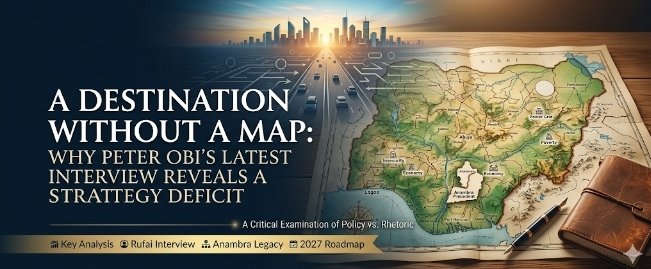
Instead, the interview revealed a striking gap between aspiration and execution. What was presented was not a concrete strategy, but a collection of well-intentioned wishes paired with an empty policy file.
The Danger of Slogan-Led Governance
Throughout the broadcast, the core issue remained a lack of specificity. When pressed on the fundamental pillars of national development—namely power sector reform, education, and national security—Obi consistently retreated to a familiar refrain: “Don’t worry, I’ll do it. I did it in Anambra.”
In modern political discourse, referencing past governance is standard practice. However, past performance must serve as a proof of concept, not a substitute for contemporary policy. Managing a diverse federal republic of over 200 million people presents a radically different scale of complexity than administering a single state. Relying on past reputation without detailing systemic solutions is not a strategy; it is a slogan.
Deconstructing the “Anambra Myth”
To evaluate the candidacy objectively, we must look closely at the “Anambra precedent.” The systemic crises currently facing Nigeria include:
- Widespread national insecurity and regional instability
- Multidimensional poverty affecting tens of millions
- A structurally deficient national power grid
- Severe currency devaluation and macroeconomic instability
- An unsustainable national debt trap
These are macro-level federal crises. They fell entirely outside the jurisdiction and constitutional powers of a state governor. Consequently, successfully managing a subnational economy does not automatically translate to solving complex federal emergencies. One cannot use the absence of a problem in the past as proof of an ability to conquer it in the future. Without specific, scalable policies, history risks becoming mere storytelling.
The Road to 2027: Describing vs. Driving
The primary takeaway from the interview is straightforward: Peter Obi is highly capable of describing the Nigeria that citizens want to see. He articulates the collective frustration and the desired destination with clarity. What he failed to demonstrate, however, is a credible, detailed, and executable pathway to get there.
As the political landscape shapes up for 2027, the opposition faces a critical challenge. If this interview represents the peak of their policy offering, the movement possesses a candidate who can vividly describe the destination, but has yet to prove he can drive the car.
A destination without a map is not a plan. It is simply a wish.